

Refineries hit in Kuwait, Haifa; Israel assassinates two Iranian military officials; Al-Aqsa closed for Eid prayers for the first time since 1967
Drop Site Daily: March 20, 2026


Israel bombs targets east of Tehran. IRGC officials assassinated by Israel. Netanyahu says Israel will “hold off” on further attacks on Iran’s energy facilities. Kuwait refinery hit for the second time. Israel bombs Syria. Drone strike on Haifa oil refinery in Israel. IRGC claims it hit F-35 over central Iran. U.S. fast-tracks $16.5B in arms sales to Gulf allies amid Iran strikes. 3,200 vessels stranded west of Strait of Hormuz. Lebanon signals readiness for immediate talks with Israel. Al-Aqsa mosque closed for Eid. U.S. proposal calls for full Hamas disarmament in Gaza. Senate panel advances nomination of Sen. Markwayne Mullin to lead DHS. Tulsi Gabbard says American and Israeli war aims in Iran diverge. Trump administration pushes to deport 5-year-old. Pentagon to extend National Guard deployment in Washington through 2029, ABC reports. Mexican fuel shipments to Cuba remain paused. Mexican forces kill 11 in raid leading to the capture of Sinaloa Cartel faction leader. Drone strike from Sudan kills 17 in Chad, risking escalation. DRC and Rwanda agree to de-escalate after Washington talks. FIFA keeps Iran World Cup matches in the U.S., declines action on Palestinian complaint.
NEW from Drop Site: On the ground report from Kabul: Strike on rehab center that killed at least 400 leaves families searching for missing. Rep. Chris Deluzio (D-Pa.) to reject future AIPAC donations.
This is Drop Site Daily, our free daily news recap. We send it Monday through Friday.
War on Iran
Israel bombs targets east of Tehran: The Israeli military said on Friday it has begun striking targets east of Tehran. Late on Thursday, the Israeli military said it had carried out over 130 strikes on targets in western and central Iran over the previous day.
Iranian officials assassinated by Israel: Israel said it killed the head of the Intelligence Division of the paramilitary Basij Force, Esmail Ahmadi, as well as several other senior commanders in a strike in Tehran on Friday. Earlier on Friday, Iranian state media said the spokesperson for the Islamic Revolutionary Guard Corps (IRGC), Ali Mohammad Naini, had been killed in an airstrike that was later confirmed to be Israeli. Hours before his death, Naini issued a statement insisting Tehran was still able to build missiles despite U.S. and Israeli attacks, countering a claim by Israeli Prime Minister Benjamin Netanyahu.
Netanyahu claims Iran’s nuclear and missile capabilities are severely degraded: Israeli Prime Minister Benjamin Netanyahu claimed in a press conference in Jerusalem on Thursday that Iran no longer has the ability to enrich uranium or produce ballistic missiles. Other notable comments:
Netanyahu also said Israel would avoid further strikes on energy sites at President Donald Trump’s request and backed Trump’s claim that Israel “acted alone” in attacking the South Pars facility.
He continued to urge Iranians to overthrow their government, saying that regime change would require a significant “ground component” of Iranians themselves.
Netanyahu addressed the closure of the Strait of Hormuz, saying that the war with Iran could accelerate plans to bypass maritime “chokepoints” through new oil and gas routes, including pipelines running west across Saudi Arabia to Israeli ports. He framed the idea as part of a broader “land bridge” vision linking Asia to Europe, arguing it could stabilize global energy flows.
Kuwait refinery hit for second time: Drones struck the Mina al-Ahmadi refinery in Kuwait for the second day on Friday, with fires breaking out across multiple units at the facility. Iran is increasingly targeting energy sites in the Gulf after Israel attacked Iran’s South Pars offshore natural gas field earlier this week.
Israel bombs Syria: The Israeli military said it targeted sites in Sweida in southern Syria on Friday in response to what it said were attacks against the Druze community.
Israel says it carried out first strikes on Iranian navy in Caspian Sea: The Israeli military said on Thursday that it struck Iranian naval infrastructure at a port and base in the Caspian Sea, targeting its missile ships, patrol vessels, and naval facilities. The operation was described as an effort to disrupt the Iranian navy’s operations and to degrade command and operational capacity in the region.
Strike on Haifa oil refinery in Israel: An Iranian missile attack struck an Israeli refinery in Haifa on Thursday, damaging electrical infrastructure. In a statement, Israeli Energy Minister Eli Cohen said power was briefly disrupted as a result of the attack on the Oil Refineries Ltd facility before being restored for most customers.
Israeli reservist charged with spying for Iran: Israeli authorities announced on Friday they arrested an army reservist on charges of spying for Iran. Police claimed the reservist, Raz Cohen, maintained contact with Iranian intelligence for months before the war and that he passed on sensitive information, including details related to Israel’s Iron Dome system, where he had previously served. According to Haaretz, prosecutors “allege Cohen’s Iranian handler asked him for the names of associates of high-ranking officials and members of the Knesset, as well as the names of senior IDF officers and pilots.” Read Drop Site’s previous coverage of Iran’s attempts to recruit Israeli citizens as spies here.
U.S.-linked facility near Baghdad airport targeted dozens of times: A former U.S. base near Baghdad’s airport that still supports American operations has been hit at least 65 times since early March, according to an Iraqi security report obtained by the Associated Press, with most attacks involving drones. While many attacks were intercepted, a recent rocket strike wounded four airport personnel. Iraqi militias backed by Iran have claimed responsibility for a number of these strikes.
Iraq’s PMF says airstrikes killed fighters in the north: Airstrikes killed two fighters from Iraq’s Popular Mobilisation Forces in northern Iraq, with the group blaming Israel and the United States for the attacks on positions in Nineveh and Salah al-Din provinces.
IRGC claims it hit F-35 over central Iran: Iran’s Islamic Revolutionary Guard Corps said its air defenses struck a U.S. F-35 fighter jet around 2:50 a.m. over central Iran, claiming the aircraft was seriously damaged and may have crashed. The group said the incident followed the interception of more than 125 “American-Zionist” drones. A spokesperson for Central Command later announced a fifth-generation F-35 was forced to make an emergency landing, and that the aircraft landed safely; the incident is now “under investigation.”
U.S. reportedly launches ground-based missiles at Iran from Gulf territory: The United States has used ground-launched ballistic missiles in its war on Iran, marking the first combat use of its newer long-range Army systems, according to the Wall Street Journal. The missiles’ limited range suggests launches from nearby Gulf territory, with verified footage indicating at least some launches from Bahrain. Iran’s Foreign Minister Abbas Araghchi also alleged that U.S. forces struck Kharg Island from the United Arab Emirates earlier this week.
U.S. weighs options to seize or blockade Iran’s Kharg Island to reopen Hormuz: The Trump administration is considering plans to occupy or blockade Iran’s Kharg Island, a key oil export hub, to pressure Tehran to reopen the Strait of Hormuz, according to Axios, though no decision has been made. Officials say the move would likely follow further strikes to weaken Iranian defenses and could require additional troop deployments to the region.
UAE says $1.4 trillion U.S. investment plan will proceed despite war: The United Arab Emirates will continue its $1.4 trillion long-term investment framework with the United States despite the war with Iran, Ambassador Yousef Al Otaiba said in a letter, according to Bloomberg. “The UAE’s $1.4 trillion investment… will stay on track with plans to accelerate deployment and funding [to the framework,” Otaiba reportedly wrote.
UN shipping agency says 3,200 vessels stranded west of Strait of Hormuz: About 20,000 seafarers are stranded aboard ships as attacks on commercial vessels disrupt transit through the Strait of Hormuz, the International Maritime Organization said at a March 19 emergency meeting in London. Roughly 3,200 vessels are confined in the Gulf, including around 450 oil and gas tankers, 150 container ships, and 200 bulk carriers. Crews are facing worsening conditions, with reports of rapidly dwindling food and water supplies.
Iran establishes controlled shipping corridor through Hormuz: Iran is allowing select vessels to transit the Strait of Hormuz along routes inside its territorial waters with prior approval, according to Lloyd’s List. At least one tanker reportedly paid around $2 million for passage. India, China, Pakistan, Iraq, and Malaysia have made requests to coordinate passage with Tehran. Ships linked to the United States or Israel will be excluded from this route.
G7 allies signal coordinated response to Hormuz disruption: The United Kingdom, France, Germany, Italy, the Netherlands, and Japan issued a joint statement on Thursday expressing their “readiness to contribute to appropriate efforts to ensure safe passage through the Strait.” There was little detail on any immediate measures and German Chancellor Friedrich Merz reiterated that any contribution to securing the strait would come only after hostilities ended, according to Reuters.
U.S. fast-tracks $16.5B in arms sales to Gulf allies amid Iran strikes: The United States has approved more than $16.5 billion in arms sales to the United Arab Emirates, Kuwait, and Jordan. Secretary of State Marco Rubio issued emergency waivers for the sales, skirting congressional review to fast-track the transactions. The packages focus heavily on air and missile defense systems and aircraft upgrades. U.S. officials say the move aims to rapidly reinforce Gulf defenses, as the region comes under fire during the U.S. and Israel’s campaign against Iran.
Lebanon
The Israeli assault on Lebanon continues:
On Friday, Israeli air strikes on a home in Bafliyeh, near Tyre killed at least two people, according to Lebanon’s National News Agency (NNA).
On Thursday, An Israeli air strike on a house on the outskirts of Adloun killed two people, NNA reported.
Two more people were killed, and eight were wounded, in an Israeli attack on the Tyre district, according to Al Jazeera.
Israel shelled the entrances to the towns of Chihine and Marwahin in southern Lebanon, near the country’s border with Israel.
Sheikh Ragheb Harb University Hospital in Toul, near Nabatieh, said in a statement that an Israeli attack on an adjacent building had caused significant damage to a number of the hospital’s facilities, including its intensive care unit.
Lebanon signals readiness for immediate talks with Israel: Lebanese Prime Minister Nawaf Salam said Lebanon is ready for “immediate negotiations” with Israel and urged President Donald Trump to play a “decisive” role in ending the war, in comments he made to CNN on Thursday. Lebanese President Joseph Aoun has proposed a “four-point plan,” which would include a “complete truce” and the disarmament of Hezbollah.
IDF says it has hit over 2,000 targets in Lebanon: The Israeli military said its 91st, 146th, and 36th divisions are continuing ground raids in southern Lebanon as part of a “forward defense” campaign, claiming it has destroyed roughly “120 command centers,” more than “100 weapons depots,” and over “130 rocket launch sites.” It also said more than 570 Hezbollah fighters have been killed, including members of the Radwan force and senior field commanders, adding that operations will continue against the group. Lebanon’s Health Ministry said Thursday that at least 1,001 people have been killed and 2,584 wounded since the start of Israeli attacks.
The Gaza Genocide, Israel and the West Bank
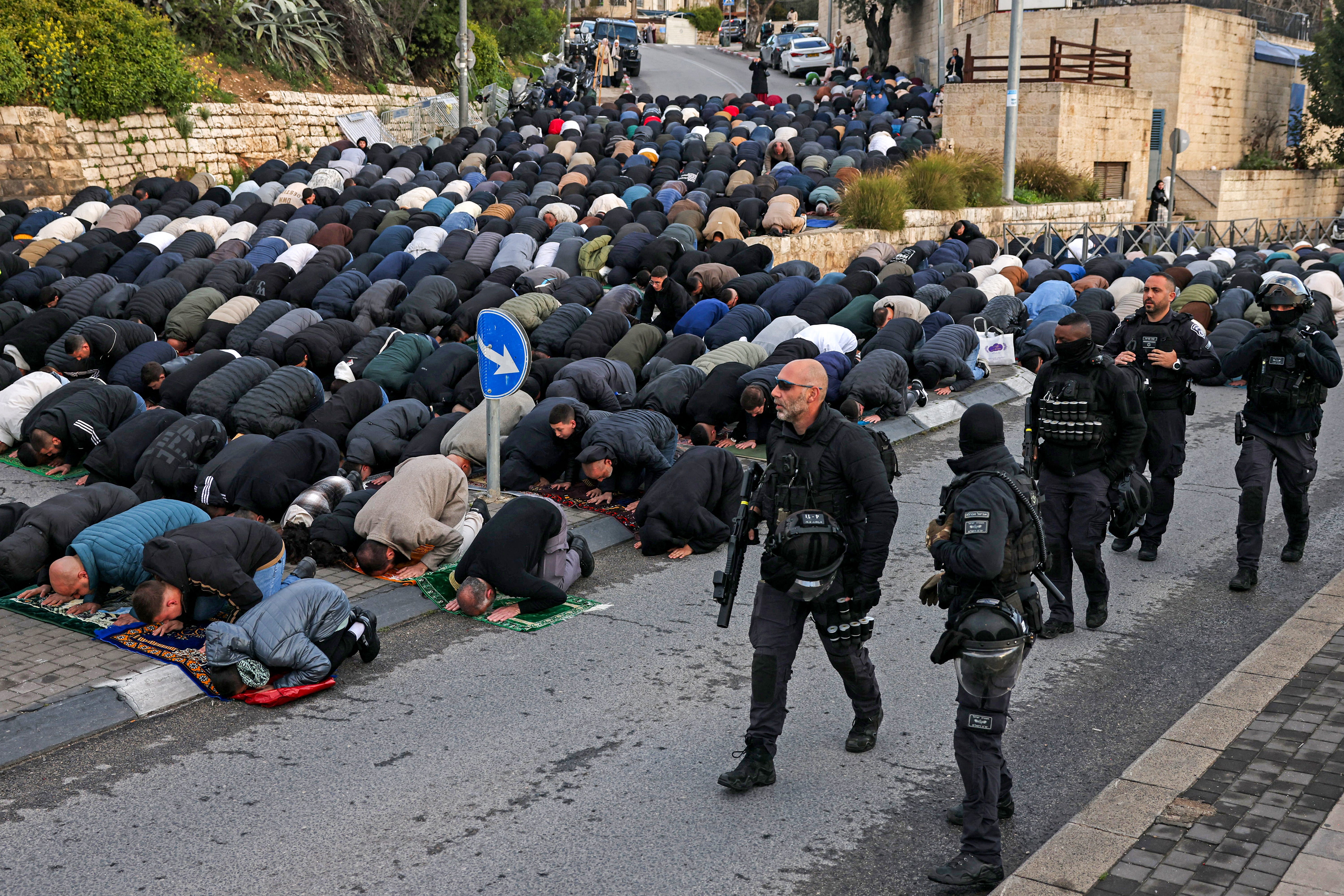
Al-Aqsa mosque closed for Eid: Israeli occupation forces have kept the Al-Aqsa compound closed for Eid prayers for the first time in nearly 60 years. Hundreds of Palestinian Muslims held Eid al-Fitr prayers at the gates of the Old City after being prevented from entering. It marks the first time the site is fully closed on Eid al-Fitr—the holiday on which Muslims mark the end of the holy month of Ramadan—since 1967 when Israel occupied East Jerusalem. Israeli occupation forces have kept Al-Aqsa and the Church of the Holy Sepulchre closed since the launch of the war on Iran.
U.S. proposal calls for full Hamas disarmament in Gaza: U.S. mediators presented Hamas with a proposal requiring the complete handover and decommissioning of all weapons in Gaza in exchange for large-scale reconstruction. The plan was reportedly delivered to the group’s representatives in Cairo. Hamas has described the offer as “take it or leave it” and is weighing its response. The Israeli military also reported that it “eliminated” Muhammad Abu Shaleh, the military intelligence head of Hamas’ Khan Younis brigade. The group has yet to confirm his death.
Aid to Gaza has plunged by 80% since Iran war began, according to latest figures: The number of aid trucks entering Gaza has dropped by about 80% since the war with Iran began, according to figures from an Israeli coordination center reported on by Haaretz, with deliveries falling sharply from prewar levels and fewer than 400 trucks entering in recent days. Israeli authorities also said that they have suspended all aid shipments from UNICEF due to the discovery of “undeclared items” among their medical supplies. The decline has driven steep food price increases and widespread shortages of basic goods and medical supplies in Gaza.
United States
By Julian Andreone, with Ryan Grim. Have a tip on Capitol Hill? Email Andreone at Julian@dropsitenews.com.
Senate panel advances nomination of Sen. Markwayne Mullin to lead DHS: The Senate’s Homeland Security Committee advanced Senator Markwayne Mullin’s nomination to head the Department of Homeland Security on a near party-line vote. The Republican committee chair, Senator Rand Paul (R-Ky.), voted against the move, after demanding why Mullin had vocally supported a physical attack on Paul in 2017. A single Democrat, Senator John Fetterman (D-Pa.), voted for Mullin. The nomination now moves to the full Senate, where Mullin’s confirmation is likely.
Tulsi Gabbard testifies that American and Israeli war aims in Iran diverge: Director of National Intelligence Tulsi Gabbard told lawmakers on Thursday that U.S. and Israeli objectives in the war in Iran are not aligned. “We can see…that the Israeli government has been focused on disabling the Iranian leadership and taking out several members, obviously beginning with the Supreme Leader,” Gabbard told the House Permanent Select Committee on Intelligence. The U.S. objectives are, according to Gabbard, “to destroy Iran’s ballistic missile launching capability, their ballistic missile production capability, and their navy.” She was questioned about the resignation of counterterrorism director Joe Kent, who said that Iran did not pose an imminent threat of attack. A full summary of the intelligence briefing is available from Responsible Statecraft here.
Japan’s Takaichi meets with Trump the White House: Japanese Prime Minister Sanae Takaichi sought to reaffirm ties with President Donald Trump during a White House meeting, as Trump pressed her to support efforts to secure the Strait of Hormuz, a critical route for Japan’s energy imports, and to discuss coordination in the Indo-Pacific, a concern of Takaichi’s administration. The leaders also signed a $40 billion nuclear reactor deal and emphasized broader security coordination. Trump responded to a question from the press about why the U.S. did not inform its allies before going to war against Iran, saying, “We didn’t tell anyone about it. Who knows better about surprise than Japan? Why didn’t you tell me about Pearl Harbor, OK?”
Trump administration pushes to deport 5-year-old: The Trump administration is continuing its efforts to deport Liam Conejo Ramos, a 5-year-old Ecuadorian boy whose detention in Minnesota has drawn widespread attention, by seeking to dismiss his family’s asylum case without a full hearing. The family’s lawyers have appealed the decision, arguing they entered legally and deserve due process. “Considering all this family has gone through, the trauma and public reaction, it’s unbelievable that the government is continuing to traumatize them,” one of their attorneys told the New York Times.
Pentagon to extend National Guard deployment in Washington through 2029: The Pentagon is preparing to maintain a federal National Guard mission in Washington, D.C., through January 2029, pending final approval from War Secretary Pete Hegseth, according to ABC. Nearly 3,000 troops are currently deployed in the capital, as part of a mission called “Make D.C. Safe and Beautiful.”
Court ruling throws student loan repayment program into uncertainty for millions: A federal appeals court has nullified the Biden-era SAVE income-driven repayment plan, potentially forcing millions of borrowers back into repayment, though the Trump administration has yet to resume collections. The decision of the Eighth District and its possible effects for borrowers and for the GOP’s election prospects are covered in the latest from David Dayen at The American Prospect, available here.
Other International News
Mexican fuel shipments to Cuba remain paused for now: President Claudia Sheinbaum said on Thursday that oil shipments to Cuba remain paused, but that her government is exploring options to resume them without harming Mexico’s economy, and stressed the importance of supplying the island. Mexico had become Cuba’s top crude supplier after U.S. pressure disrupted Venezuelan exports to the island; fuel deliveries from Mexico to Cuba halted in January.
Mexican forces kill 11 in raid leading to the capture of Sinaloa Cartel faction leader: Mexican authorities said 11 people were killed during a navy raid in Culiacán that resulted in the capture of Omar Oswaldo Torres, a leader of the Los Mayos faction of the Sinaloa Cartel. Officials said security forces came under fire and seized high-powered weapons at the scene. A woman the military identified as Torres’ daughter was present during the raid, but she was released to her family because she had no established link to her father’s criminal activity.
Drone strike from Sudan kills 17 in Chad, risking escalation: A drone attack launched from Sudan killed 17 people in the border town of Tine in Chad. Among the dead were mourners at a funeral, according to the government, which has threatened retaliation and bolstered forces along the frontier. Sudan’s paramilitary Rapid Support Forces denied involvement and blamed the Sudanese army.
DRC and Rwanda agree to de-escalate after Washington talks: The Democratic Republic of Congo and Rwanda agreed to measures to reduce tensions following talks in Washington, committing to respect sovereignty, disengage forces, and protect civilians, according to a joint statement. Rwanda pledged a phased withdrawal from eastern DRC, while Kinshasa said it would intensify efforts against the Democratic Forces for the Liberation of Rwanda armed group.
Middle East war drives price shocks in Africa: Escalating conflict in the U.S.-Israeli war with Iran is pushing up fuel, fertilizer, and food prices, putting fragile countries at risk of deep hunger, with up to 45 million more people potentially affected this year. Sudan and Somalia are among the most exposed, due to reliance on imports through the Strait of Hormuz; rising fuel costs threaten agriculture amid declining humanitarian aid.
FIFA keeps Iran World Cup matches in U.S., declines action on Palestinian complaint: FIFA said Iran’s 2026 World Cup matches will remain in the United States despite Iranian objections, with President Gianni Infantino saying the tournament will proceed as scheduled. The organization also rejected a Palestinian Football Association request to sanction Israel over settlement teams, citing legal complexity, but fined Israel’s federation for discrimination and ordered corrective measures.
On the ground report from Kabul: Strike on rehab center that killed at least 400 leaves families searching for missing: An airstrike by Pakistani jets struck Kabul’s overcrowded Omid rehabilitation center during iftar, killing hundreds of patients and injuring many more, according to Taliban officials and witnesses. In the aftermath, families searched hospitals and morgues across the city for missing relatives. The strike is part of a sharp escalation in cross-border violence tied to long-standing tensions along the Durand Line. The full article from Fazelminallah Qazizai and Emran Feroz for Drop Site is available here.
As Pakistan bombed villages in Afghanistan, the Pakistani government was busy purchasing luxury Gulfstream jets: As bombs fell in Kabul, the son of the Chief Minister of Punjab province took a newly purchased, approximately $50 million Gulfstream G500 jet to Vienna on his honeymoon. After Drop Site journalist Waqas Ahmad reported on it, the Pakistani government resorted to online threats.
More from Drop Site
EXCLUSIVE: Rep. Chris Deluzio (D-Pa.) to reject future AIPAC donations
Programming note: You can sign up here to get updates from us on our WhatsApp channel.
If you want to continue getting this newsletter, you don’t have to do anything. But if this is too much—we do try to be mindful of your inbox—you can unsubscribe from this newsletter while continuing to get the rest of our reporting. Just go into your account here at this link, scroll down, and toggle the button next to “Drop Site Daily” to the off setting. It looks like this:

The sheer scope of what’s happening right now should alarm anyone paying attention. We’re watching a rapid escalation from shadow conflict into open, multi-front warfare—strikes deep into Iran, attacks on energy infrastructure from Kuwait to Haifa, and now even disruptions threatening the global economy through the Strait of Hormuz. This isn’t “deterrence”—it’s a widening regional war with global consequences.
What’s especially disturbing is how normalized some of these actions have become. Assassinations of officials, bombing campaigns across multiple countries, and the closure of Al-Aqsa Mosque during Eid—something that hasn’t happened since 1967—are treated like routine developments instead of historic escalations.
At the same time, the U.S. fast-tracking billions in weapons and openly discussing options like blockades or seizures of territory suggests this is not de-escalation—it’s preparation for something much bigger. Meanwhile, civilians across the region—from Gaza to Lebanon to Iran—are the ones paying the price, while global shipping, food supply chains, and energy markets start to buckle.
If this continues, the question isn’t whether things get worse—it’s how far this spreads, and how many people get pulled into a war they never chose.
US hegemony & Israeli dream of same created this nightmare scenario. The constant barrage of slaughter & destruction have become part of my daily doom scroll. I can't quite allow myself to linger over each atrocity, for fear my heart & brain will break. Still, not quite normalized to the horror, as my soul weeps at the stupendous immorality exhibited by neoliberal capitalism run amok. And then embarrassingly, tho gratefully, return to my laundry.