

Peace Abroad, War Next Door: Pakistani Airstrikes Devastate Afghan Civilians
While Pakistan presents itself as a mediator between Iran and the United States its attacks on Afghan civilians are ravaging border villages.

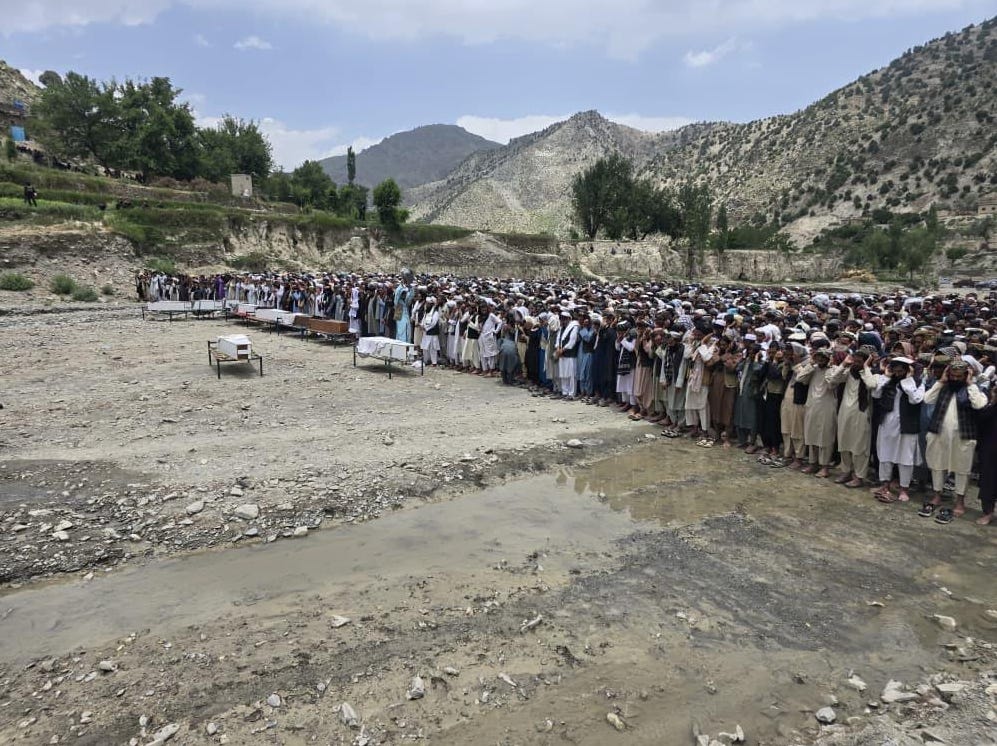
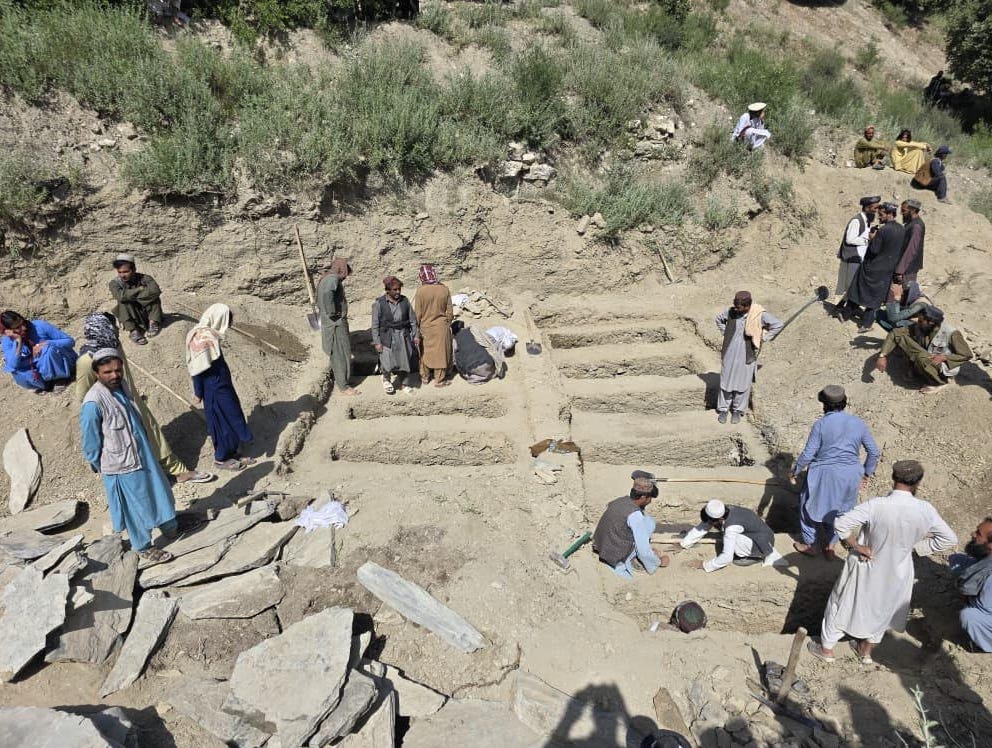
In the village of Mana, located in Afghanistan’s Khost province, close to the Pakistani border, men who normally pass their days farming instead spent the morning of June 10 digging fresh graves for their murdered relatives and neighbors.
The night before, shortly after midnight, Pakistani drones and fighter jets flattened the neighboring homes of two brothers, Siraj and Babri. Nine members of a single family were killed, most of them women and children.
The two brothers’ homes stood beside one another in Mana. Neighbors worked through the night dragging the dead and the wounded out of the debris. Across the two households, ten more people were wounded, several of them in critical condition. The survivors were rushed first to a small district hospital, before being transferred to the largest provincial hospital in Khost.
A doctor at the hospital, who asked not to be named because medical staff have been warned against speaking to journalists, told Drop Site that 11 bodies were brought in after the strike, including women, children, and men—every one of them a civilian. Among the wounded survivors were three children.
These are not isolated tragedies—they are the latest episodes in a campaign that Drop Site has been documenting along the border since the winter, one in which Pakistan, while presenting itself to Washington and Tehran as an indispensable peacemaker, has bombed Afghan villages, hospitals, schools and markets, emptied entire districts along the border, and blockaded roads until clinics ran out of medicine.
By the United Nations’ own conservative count, Pakistani operations had already killed hundreds of Afghan civilians this year before the June 10 strikes. What plays in Islamabad’s conference halls as “counterterrorism operations,” appears, from Khost and Paktika, like indiscriminate punishment of Afghans living along the border demarcation line.
By April 1, the United Nations Assistance Mission in Afghanistan (UNAMA) had verified at least 372 civilian deaths from Pakistani operations in Afghanistan, though the actual death toll in an area largely sealed off to independent monitors is likely higher.
The attack on Mana was not the only deadly incident in the region that night. Pakistani aircraft also struck a series of buildings in neighboring Paktika province. Taken together, the bombardment of Khost and Paktika killed or wounded at least 23 civilians in a matter of hours, locals said.
By the following morning in Mana the bodies had been washed, wrapped, and carried into the open for a mass funeral. At the ceremony, hundreds gathered under chants of “Allahu Akbar,” as they prepared to bury the victims, the majority of whom were children and women.
The crowd was furious. Mourners called for international human rights organizations to open an impartial investigation into the killings and demanded that those responsible be brought to justice.
Noor Badshah Khan, a tribal elder from the area, addressed the crowd and blasted Pakistan for waging a merciless campaign against ordinary Afghans.
“When will these crimes stop? When will they stop slaughtering the children of this soil?” he asked.
The attack on Paktika killed three more children: 10-year-old Nazam Khan, his younger sister Khadeja, and their cousin Mozdalafa.
The three had spent the evening counting the stars and bickering over the number before they drifted off to sleep in the open air, family members told Drop Site.
The blast destroyed the house, killed the family’s livestock, and hurled the children’s father, Sher Mast, some 60 feet through the air. He and his wife survived the attack that killed their children, though both were badly wounded.
A neighbor who reached the wreckage within half an hour gathered what remained of the three children by torchlight. The next day they were lowered into three small graves dug side by side, the eldest boy’s shroud still wet with blood.
The War After the War
Along this stretch of border, the drones that fly overhead day and night have their own nickname. Villagers call them “bangana,” the Pashto word for a buzzing wasp. For the children of Khost and Paktika, that sound is now woven into their daily lives.
War has become a tragic constant of life in the region. The same valleys were bombed during the Soviet occupation of Afghanistan during the 1980s, and again during the two-decade long U.S.-led war and occupation. Now, the hostile aircraft overhead are operated by a Pakistani regime that enjoys close ties with Washington.
The drones inflict a particular type of psychological torment on residents of the region. Locals describe a feeling of helplessness—they can hear the machines, but never reach them, and their own government has no capacity to to stop them.
The grief inflicted by the recent attacks in Khost and Paktika has eroded long-standing cultural traditions in the area. By custom, after a death, neighbors cook for a bereaved family for three days. This time, villagers said, no one could bring themselves to eat after the massacres.
Without a responsive government, or the attention of international media, many Afghans have turned to social media in a desperate attempt to inform the world of their plight and demand accountability.
In the hours after the strikes, Afghans filled online platforms with appeals to the United Nations and the international community to hold the Pakistani military to account, describing the bombardment as a direct assault on Afghanistan’s national sovereignty.
While Pakistan has justified its attacks as a response to terrorist attacks on its soil blamed on the Tehrik-i-Taliban Pakistan (TTP), locals say that the justifications are an attempt to mask the real motives for the ongoing attacks on a border zone that has long been disputed between the two countries.
“This is indeed a continuation of the War on Terror in Afghanistan,” said Mohammad Zaher, a local from Khost. “It was clear that it would not stop after the first drones reappeared after the U.S. withdrawal.”
“Precise and Calibrated”
Islamabad tells a different story about its attacks. Pakistan’s information minister, Attaullah Tarar, described the operation as “precise and calibrated,” claiming the Air Force had destroyed four militant targets and killed 26 TTP fighters. The gulf between the reported casualty figures, with Kabul recording 13 civilian dead, and Pakistan claims that double that number were killed, all terrorists, has by now become a familiar feature of the information war that accompanies the armed conflict.
Residents from the region who spoke to Drop Site rejected the Pakistani account of the strikes, stating that none of the victims had any ties to armed groups.
Pakistan’s escalating attacks on its neighbor come as the country is embracing a new international identity as a peacemaker mediating the war between Iran and the United States. Field Marshall Asim Munir, the Pakistani military’s chief of staff, has emerged as a close ally of President Donald Trump, who has praised Munir as an “exceptional human being,” while ignoring his brutal crackdowns on dissent inside Pakistan, as well as his escalating killings of Afghan civilians.
Trump’s praise for Munir as a mediator stands in stark contrast to the brutal reality of Pakistan’s military campaign against its neighbor.
Islamabad declared “open war” on the Afghan Taliban government in February after a suicide attack on a Shia mosque in Islamabad blamed on the TTP. Since that time, Pakistani airstrikes have shifted from rural areas on the border to attacks on Kabul itself, including the bombing of a rehabilitation clinic in the heart of the capital that killed hundreds in March.
Residents described the attacks on roads and local transport infrastructure as a de facto siege—depriving markets and clinics of basic goods like flour and medicine. Locals from the region told Drop Site they believed the aim of Pakistani operations was to depopulate the frontier and carve out a buffer zone, with the terror wrought by the recent bombings in Khost and Paktika helping achieve the same goal by encouraging flight from the area.
While the newest phase of the war between the two neighbors has been justified as a counterterrorism operation, Afghans note that Pakistani animosity towards Kabul has continued across many different regimes over the decades—with nationalist, communist, democratic, and Islamist governments all targeted by Islamabad in a bid to ensure that its neighbor remains too weak and unstable to assert its own territorial claims.
“This is an endless cycle and you don’t need any educated analyst, military expert or historian to understand it,” said Ali Khan, a resident of Kabul and former soldier of the U.S.-backed Afghan army that collapsed in 2021. “You just need to talk to the people who have been affected by these policies for decades.”
Pakistan’s confrontation with Afghans is increasingly taking place on both sides of the border. After years of hosting a large refugee population, hundreds of thousands of Afghans have recently been deported from Pakistan back to Afghanistan—in many cases placing them back in the same border villages and provinces that are currently under attack by Pakistani drones and aircraft.
“Afghans are a population to be managed, leveraged, and disposed of, never quite people”, said Ali Khan. Because of his own affiliation to the former army of the Afghan Republic, he himself fled to Pakistan, and then Iran during the last four years, before he ultimately returned home to Kabul earlier this year.
“It’s better for me to hide in Kabul, see my family and live with some level of dignity instead of being beaten and deported by our neighboring countries,” he said.
Afghanistan-based journalists Fazelminallah Qazizai and Mohammad Zaman Nazari contributed to this report.
 | A guest post by
|
Perhaps there should be some mention that the current government in Pakistan is there because of, at least to some extent, the US interference there, and the imprisonment of Imran Khan.
In addition, one might speculate that the slight leverage Pakistan currently has in the talks between the US and Iran might derive from just this continuation of the WOT in Afghanistan, started by the US, and only reluctantly abandoned, as untenable, yet unfinished business.
Having seen the Israelis get away with similar attacks and denial, and given the role they have been "assigned" in the peace talks, the Pakistanis believe they have nothing to fear and they are probably correct.