

Jeffrey Epstein Recruited NSA Codebreakers for Genome “Manhattan Project”
The financier pursued cryptographers to “hack” the genetic code, and develop “new signals intelligence” to understand inter-cellular communication.


In the decade before Russia’s invasion of Ukraine in 2022, the U.S. and Russia were engaged in high-stakes exchanges of advanced technology involving the Massachusetts Institute of Technology (MIT) and the Skolkovo Innovation Center—a Russian government-backed technology hub that aimed to jump-start a “venture” innovation ecosystem in Moscow.
Jeffrey Epstein sat at the crossroads of academia, philanthropy, and venture finance as these global capital flows were threatened by the brewing confrontation in Ukraine.
In 2013, during the early cryptocurrency boom, Epstein sought an audience with Vladimir Putin to encourage the Russian president to shift course from the MIT–Skolkovo model. Instead of playing “catch up” with the United States through venture-backed startups, Epstein proposed, Russia could help lead a new financial system based on a novel global currency.
Epstein funded the early development of cryptocurrency through the MIT Digital Currency Initiative, founded in 2015. MIT’s Bitcoin Core Development Fund helped pay bitcoin’s early developers to maintain the open-source software authored by Satoshi Nakamoto, bitcoin’s anonymous inventor. Epstein was an early investor in Coinbase, and he was friends with Brock Pierce, the co-founder of U.S. dollar stablecoin company Tether, which operates, in effect, the world’s largest crypto bank.
Epstein was also recruiting cryptographers to a more ambitious project: hacking the human genome. In an email to a redacted recipient in August 2012, Epstein wrote, “My biology gurus at harvard all agree that the signal intelligence used by the various agencies , could be put to work on breaking the dna code or protein signal problems. breaking foreign codes is the expertise of the us and nsa.” Epstein prompted the recipient to help him recruit “code breakers” from the various intelligence agencies: “it would be great to know which agency button to push.”
In an interview with Steve Bannon months before his death, Epstein revealed that he had purchased a property in New Mexico—the Zorro Ranch—as a research facility to attract the nation’s top scientists from the former “Manhattan Project” campus in nearby Los Alamos after the U.S. government cut funding for high-energy physics at the end of the Cold War. “In our world, the physical world, there were things that were just unexplainable,” he told Bannon. “I wanted to see if we could build tools so others smarter than me could help investigate it.”
The millions of documents published by the Justice Department last month reveal Epstein’s disturbing fascination with eugenic science, expressed through research linked to the intelligence services of multiple governments. Epstein covertly negotiated access to dangerous and ethically dubious technology, between financial elites, often alluding to grand ambitions for reshaping both the human genome and the world order.
Drop Site News has spent the past several months exposing Epstein’s ties to U.S. and Israeli intelligence. Our full series is available here. We also partnered with Jmail in their effort to make the full Epstein files accessible and searchable. View the archive at https://jmail.world/.
If you value this reporting, can you make a tax-deductible donation today to help us keep going?
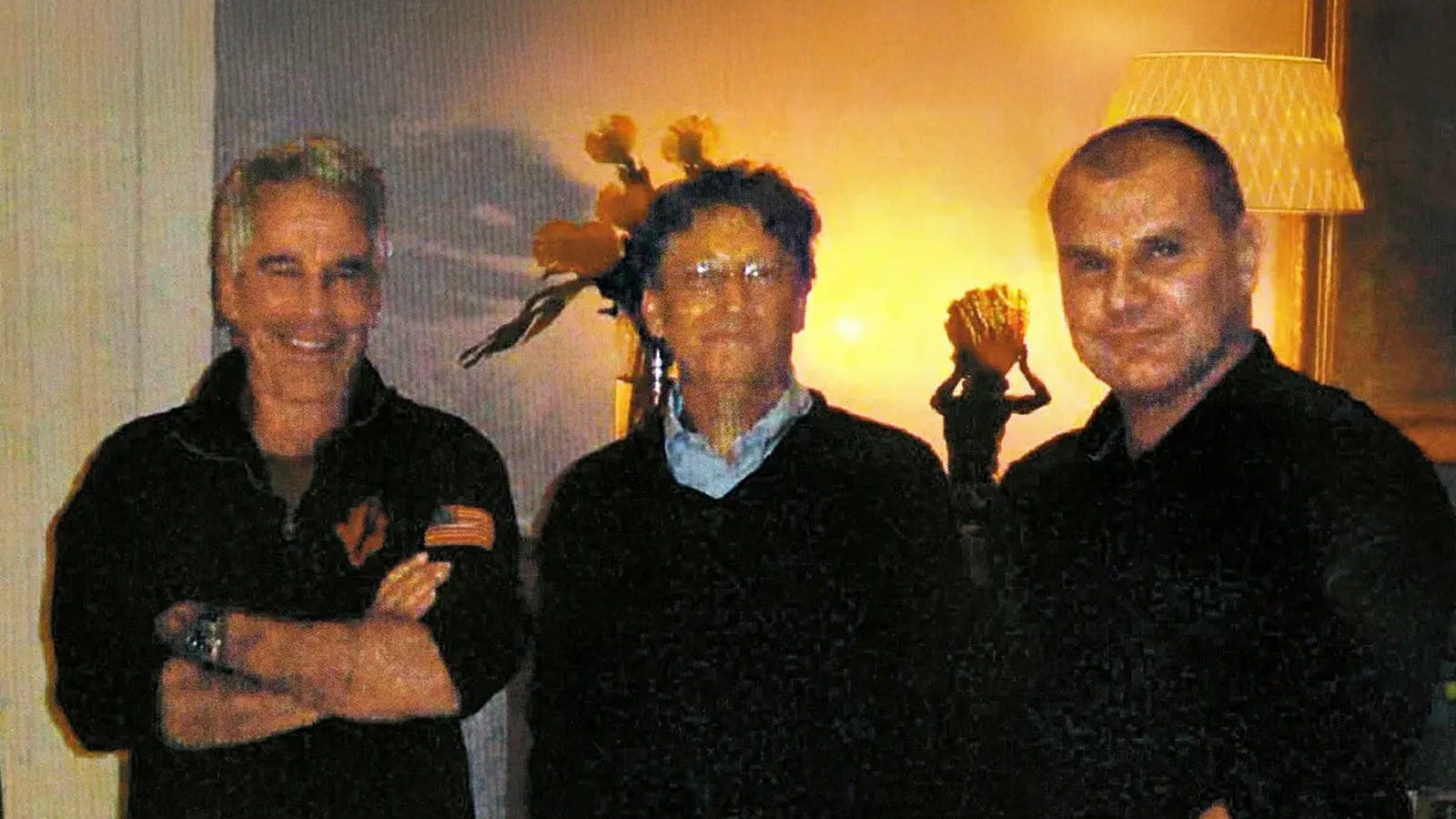
Jeffrey Epstein Recruited NSA Codebreakers for Genome “Manhattan Project”
The financier pursued cryptographers to “hack” the genetic code, and develop “new signals intelligence” to understand inter-cellular communication.
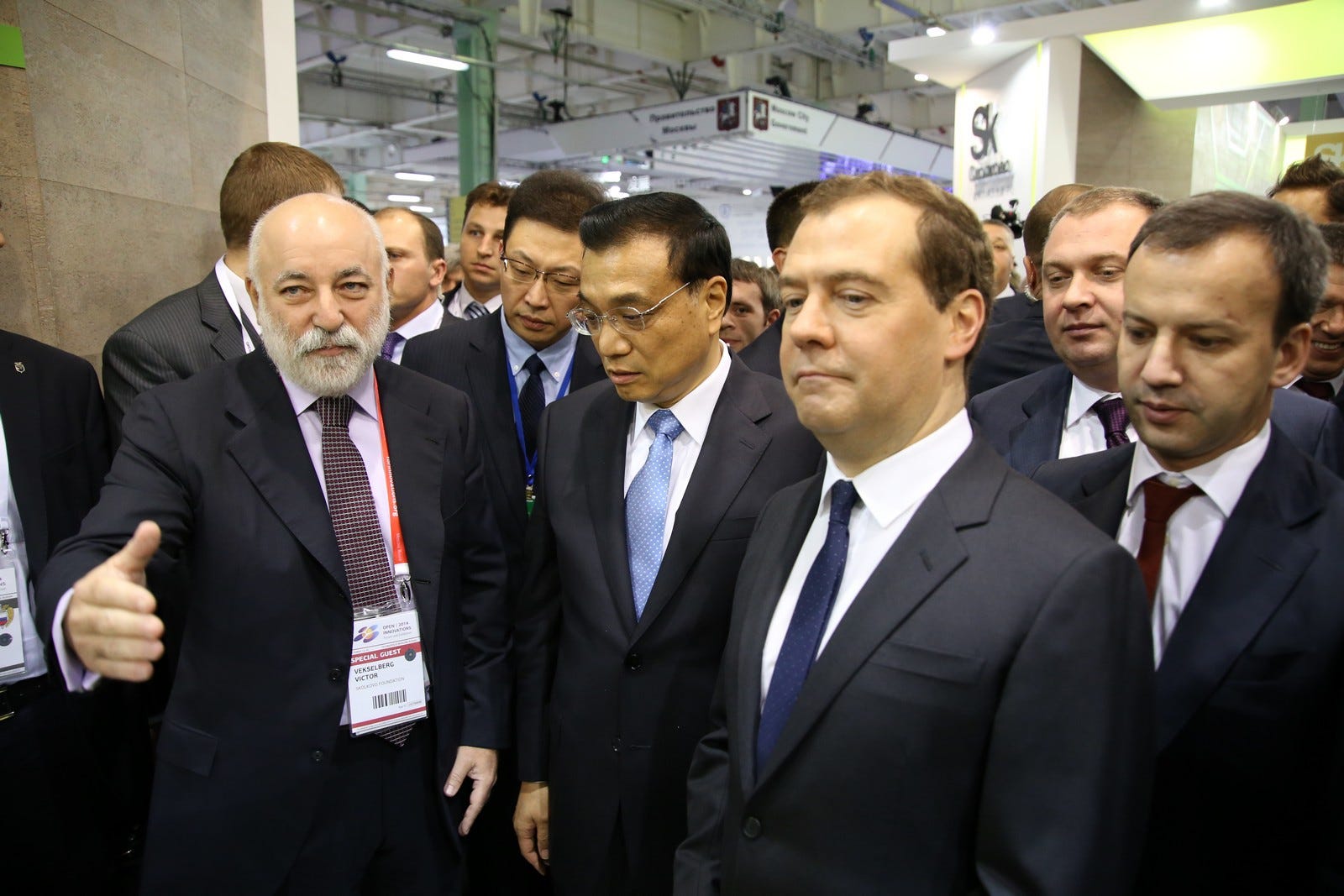
In January 2010, Ilya Ponomarev, a member of the Duma—the Russian parliament— helped arrange a visit to Massachusetts Institute of Technology (MIT) by a group of senior Russian officials. He told a Latvia-based outlet he was in Boston to explore cooperation between Russian and American startups.
Vladislav Surkov, deputy of then-President Dmitry Medvedev, was part of the delegation. At the time, Surkov was seeking to develop the “second leg” of a managed multiparty system to counter-balance Putin’s dominant United Russia Party. After the visit, Surkov asked Ponomarev, a popular member of A Just Russia, the controlled opposition party, to become a “technology transfer” advisor for Viktor Vekselberg, a Russian-Israeli billionaire.
Vekselberg, owner of the conglomerate Renova Group, was in charge of the Skolkovo Innovation Center, dubbed Moscow’s “Silicon Valley,” a high-tech business district subsidized by Russian state-owned enterprises and administered by the non-profit Skolkovo Foundation.
With Ponomarev’s help, Vekselberg established the Skolkovo Institute of Science and Technology, or “Skoltech,” a $300 million research partnership paid by the Skolkovo Foundation to MIT. MIT and Skolkovo share profits and royalties from the partnership, which includes intellectual property related to CRISPR gene-editing technology. Skoltech supported research on RNA-targeting methods using CRISPR, and also owns rights to diagnostic technology based on the same RNA-targeting effector.
Like many of his ultra-wealthy peers, Jeffrey Epstein was fascinated by gene therapy and life-extension technology. He once suggested to news anchor Katie Couric—to her shock and disgust—that he even planned to clone himself. But his interest in genomics was more than a passing fancy; it was an enduring obsession during the final decades of his life.
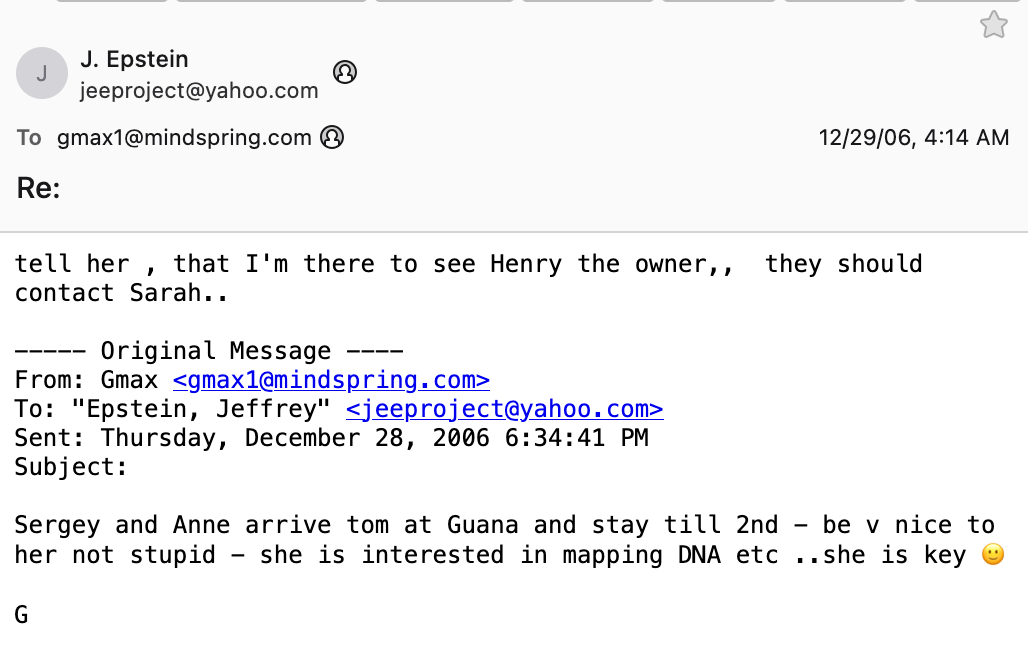
In December 2006, before Epstein was jailed for prostitution of a minor in Palm Beach, Ghislaine Maxwell invited Google co-founder Sergey Brin and his then-girlfriend Anne Wojcicki to Epstein’s Little St. James Island, according to emails in Epstein’s hacked Yahoo! inbox vetted and published by Distributed Denial of Secrets. Wojcicki had founded a personal genomics startup called 23andMe, and Maxwell encouraged Epstein to cultivate a relationship with her. “Be v nice to her not stupid,” Maxwell wrote. “She is interested in mapping DNA etc ..she is key :)”
That same year, Epstein had been in contact with leading Harvard geneticists George Church and Gary B. Ruvkun, who won a Nobel Prize in 2024 for his research into micro RNA. Epstein planned to fund Church’s Personal Genome Project at Harvard, and Ruvkun sought Epstein’s support for genomics research to elucidate “pleasure signals in the brain.” Ruvkun wrote to Stephen Kosslyn, later Harvard’s Social Science Dean, “let me know if this subject is too strange for our patron.” The correspondence was forwarded to Epstein, who wrote back, “the patron has no boundaries.”
After Epstein’s release from prison on sex crime charges in 2010, he began funding Church’s CRISPR gene-editing research. In November 2011, Church stirred some controversy by telling an interviewer that he hoped to clone a Neanderthal.
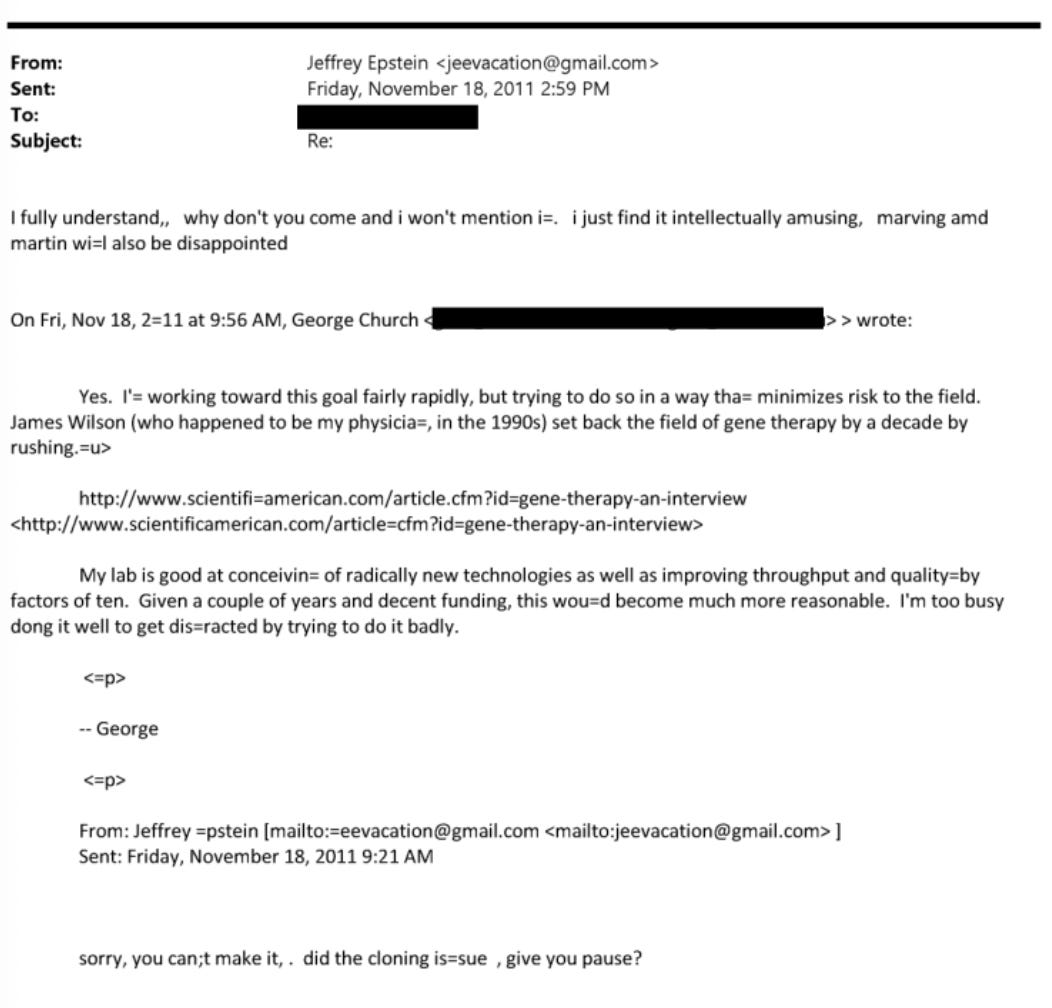
Epstein wrote to Church a few weeks later, after the scientist declined an invitation to an event, “did the cloning issue , give you pause?” Church replied, “Yes. I’m working toward this goal fairly rapidly but trying to do so in a way that minimizes risk to the field.”
“Why don’t you come and i won’t mention it,” Epstein coaxed him. “I just find it intellectually amusing.” Church did not reply to request for comment.
“Find Me The Top Hacker”
Epstein’s interest in gene-editing was not purely intellectual; it was personal. Joe Thakuria, Church’s Harvard Medical School colleague, helped Epstein conduct research on his own genome. In June 2014, Thakuria sent Epstein a $193,400 invoice for a package deal to mutate his adult stem cells “to increase longevity,” noting that “If we do this, he, like George Church, would be one of very few people in the world to have this done.” Later that year, Epstein tried to arrange a meeting between Church and Bill Gates to discuss “anti aging” and “genetic fabrication.”
MIT received millions of dollars in donations directed by Epstein to support pet projects that happened to closely intersect the frontier research conducted under the Skoltech partnership.
Epstein gave his first gift to the MIT Media Lab in 2002, to fund the research of artificial intelligence pioneer Marvin Minsky. Over the next decade, Epstein gave several large gifts to Seth Lloyd, a quantum computing researcher featured at the Russian Quantum Center in Skolkovo, who co-authored papers with Skoltech-funded researchers.
Microsoft, the technology conglomerate of which Bill Gates is a founder and major shareholder, also had formal ties to Skolkovo. In 2010, Viktor Vekselberg and Microsoft CEO Steve Ballmer signed a memorandum in Moscow to begin “a wide-ranging series of collaborative initiatives that will underpin the Russian Federation’s technology innovation agenda,” later opening an R&D center at the Skolkovo Innovation Center.
Skolkovo was one of several foreign funders of the MIT Media Lab, led by Epstein’s close friend Joi Ito. The Skolkovo partnership funded research grants for high-profile principal investigators like Chilean physicist César Hidalgo and Neri Oxman, hedge fund manager Bill Ackman’s wife, whose research Epstein had personally backed.
Epstein was also supporting the work of Madars Virza, a Latvian research scientist working on cryptocurrency at the Media Lab. In 2011, the Skolkovo Foundation funded Virza and Israeli scientist Eli Ben-Sasson’s research on Zerocash, a design for an anonymous cryptocurrency based on “zero-knowledge” cryptographic proofs—also backed by the Defense Advanced Research Projects Agency (DARPA).
In emails released by the Justice Department last month, Epstein discussed the cryptographic theory behind Zerocash with Italian hacker Vincenzo Iozzo, “ZeroCash…is essentially a ‘privacy preserving’ version of Bitcoin,” Iozzo wrote to Epstein. “If we use...similar [zero knowledge proofs] for our currency, we can enforce arbitrary rules on how the currency is spent.” Epstein invested in Ben-Sasson and Virza’s Electric Coin Company, to create the Zcash blockchain based on their research. Later, Epstein helped Virza make a bank transfer in the Virgin Islands before a “fork” in the Zcash code. Virza did not reply to request for comment.
Epstein’s interests in genes and cryptocurrency were deeply intertwined. He regarded the human genome as a cryptographic puzzle, and wanted to “hack” the genetic code.
As early as December 2009, Epstein reached out to Daniel Dubno, a CBS News producer who previously worked with DARPA and the Department of Homeland Security, to “find me the top hacker codebreaker, nsa type,” to assist in analysis of proteins.
That month, Epstein contacted MIT parallel computing pioneer Danny Hillis with the same request: “i am looking for nsa quality code theorist. biology at every level involves a host of Alice and Bob interactions, authentication, signnal processing. Noisy channels.” (In cryptographic theory, Alice and Bob are common placeholders for two parties trying to communicate with each other.)
In his messages to Hillis, Epstein seemed somewhat conversant in the frontier methods in artificial intelligence research at the time, writing, “THe math gets quite complicated. algebraic topologists ,sometimes look at the intersections in multidimensional spaces,” referring to the practice of representing a high-dimensional object as a collection of overlapping regions, then studying the pattern of their intersections.
Dubno followed up with Epstein a few months later, to inform him about a crypto workshop he was planning, with some promising recruits. “A bunch of Israeli hackers are in this with me as well as the chief disruption officer at Darpa, Dr. Peter Lee,” Dubno wrote. He added, “I’d design this so you’d get your questions answered if you’d help me get mine.” Epstein replied, “Im in.” Dubno visited Epstein’s island within a matter of days. Hillis and Dubno did not reply to requests for comment.
For the next decade, Epstein continued to recruit engineers from U.S. national security entities, including DARPA, to his genome hacking project. He asked Kathryn Ruemmler, the White House attorney who had handled the legal fallout from the Edward Snowden leaks, to help him source cryptographers from the National Security Agency. “Can you find a guy from nsa that can think about signal intelligence applied to DNA,” Epstein wrote . “I want to intercept communication between living cells in organisms.”
In late 2012, he had sent the same request to Boris Nikolic, Bill Gates’ top aide: “do you have any contacts at nsa so that we can use de encypriton (sic) in biological systems?” “Yes,” Nikolic replied, “There are no many places where I do not have someone ;)”
“A New Form Of Money”
Despite an auspicious start, the partnership between MIT and Skolkovo came under strain in 2012, caught between rising tensions between Washington and Moscow, and an increasingly restrictive political climate within Russia itself.
That year, major street protests broke out in Moscow and St. Petersburg against the Russian government. In response to the demonstrations, Putin accused the U.S. of fomenting unrest, and his foreign minister claimed the United States Agency for International Development (USAID) was attempting to influence Russia’s elections through “pro-democracy” non-profit and non-governmental organizations.
USAID was funding a major Russian civil society organization to conduct election monitoring, documenting allegations of voter fraud that fueled the protests. Ponomarev—now seen as a liberal opponent of the government—did not have public ties to USAID, which was a close partner of the Gates Foundation. Even so, as concerns mounted over his safety inside Russia, Nikolic, Gates’ science and technology advisor, quietly sought Epstein’s help to protect him.
In an email dated January 11, 2012, Nikolic asked Epstein to travel with him to Russia to meet Ponomarev. Nikolic forwarded a message from Ponomarev requesting an invitation to speak at the World Economic Forum that year “so that not only official Putin’s voice is heard.”
“He is a member of Duma,” Nikolic explained to Epstein, “and he and Alyona (his very smart and cute girlfriend) are the main organizer of the uprising against Putin…I am afraid what will happened to him. The stakes are huge.”
Nikolic believed that Ponomarev was in imminent danger. “He might replace Putin and become a president by himself (he will sooner or later) if he does not [get] killed before. It is super dangerous - any idea how to help him???” Nikolic signed off, “Pls do not forward this email.”
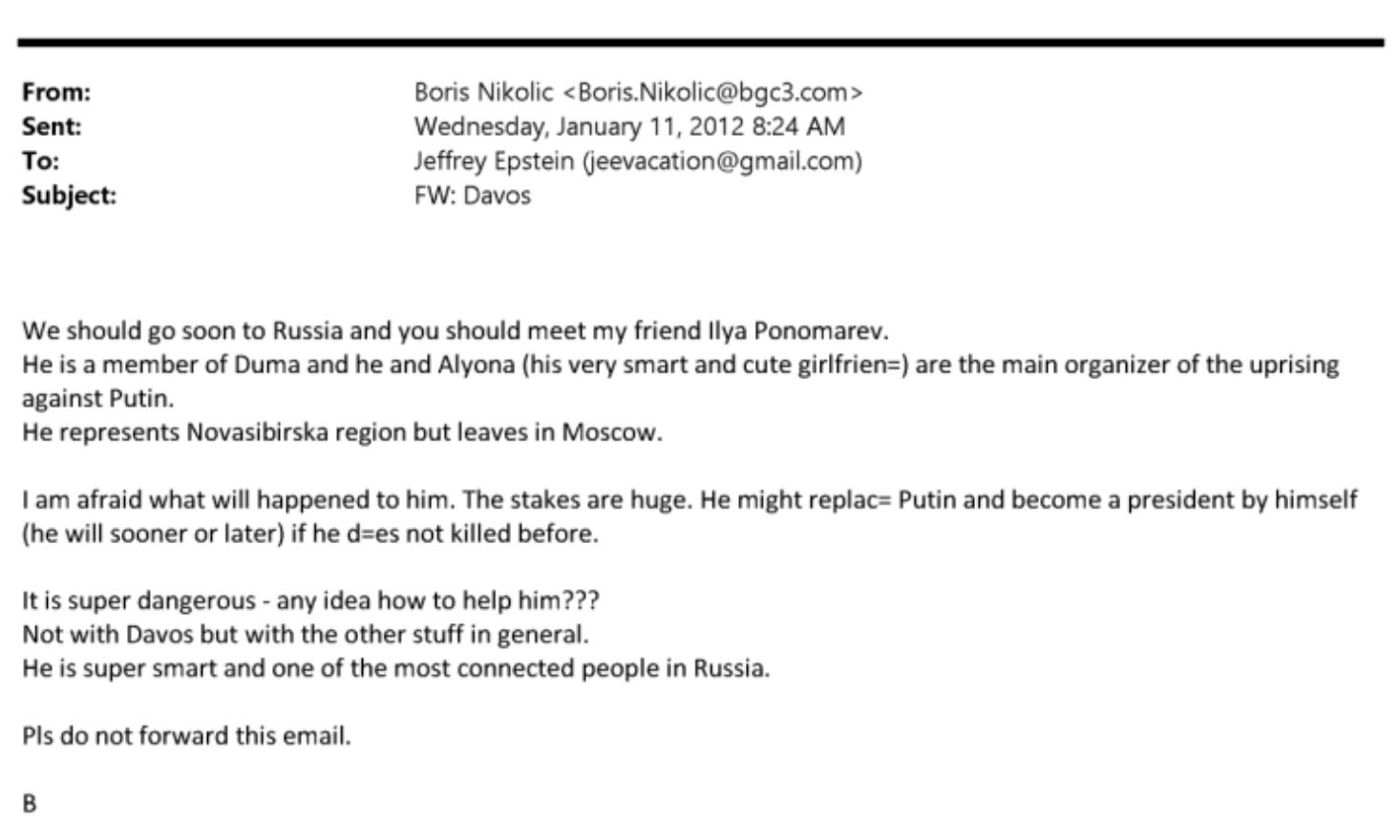
The documents do not show whether Epstein responded, or if he acted on Nikolic’s email at all. Ponomarev did not speak at Davos that year. As Nikolic had warned, Ponomarev’s status in Russia quickly became more precarious. After Putin’s return in May 2012, Ponomarev led a failed filibuster to stall a bill drastically increasing penalties for participating in protests. In June 2012, Nikolic sent another message encouraging Epstein to build a relationship with Ponomarev, writing, “It is somewhat dangerous for me to spend more time with him. But I think it is worth it.”
The next month, the Russian government adopted a new “foreign agents” framework for foreign-funded NGOs, restricting the activities of civil society organizations. In September 2012, USAID was banned from Russia.
The MIT-Skolkovo partnership became a political flashpoint as the Kremlin moved to contain Ponomarev. In March 2013, Ponomarev resigned from his political party, A Just Russia, after being forced to break with the protest movement. Ponomarev and other high-profile figures connected to Skolkovo were investigated for suspected embezzlement, and a Moscow court ordered Ponomarev to pay back his lecture fees from Skolkovo.
The same month that Ponomarev was separating from his political party in Russia, Ehud Barak stepped down as head of Israel’s Defense Ministry. With Epstein’s help, Barak quickly negotiated a lucrative consulting agreement with Renova Group—the conglomerate owned by Vekselberg, the billionaire head of Skolkovo.
Barak told reporters that his retirement meant that he now would have time to “study, write, live and enjoy.” Instead, he immediately began working with Epstein to conduct covert diplomatic work in support of Israeli security interests abroad. One of their first priorities was securing a private meeting with Vladimir Putin to discuss a Russian-led resolution to the civil war in Syria, and the peaceful removal of President Bashar al-Assad from power.
Epstein offered Barak a strategy he often employed: using non-governmental multilateral institutions to engage state leaders through backchannels. Within days of Barak’s retirement, on March 27, 2013, Epstein and Bill Gates visited Thorbjorn Jagland, a member of the Nobel Peace Prize committee, accompanied by representatives of the International Peace Institute (IPI), a non-profit think tank specializing in multilateral diplomacy.
Barak and Epstein were simultaneously using the IPI to cut a security deal for Israel in Mongolia, in hopes of accessing mining interests in that country. Barak traveled to Ulaanbataar in late April 2013, and emailed Vekselberg to set up an urgent phone call: “met with most of the leaders from the President downwards and several business people. If your plans for Tuesday [have] not been changed I have a thought that could probably help.” That Tuesday, Vekselberg and Putin attended a meeting for the Board of Trustees of the Russian Geographical Society in St. Petersburg.
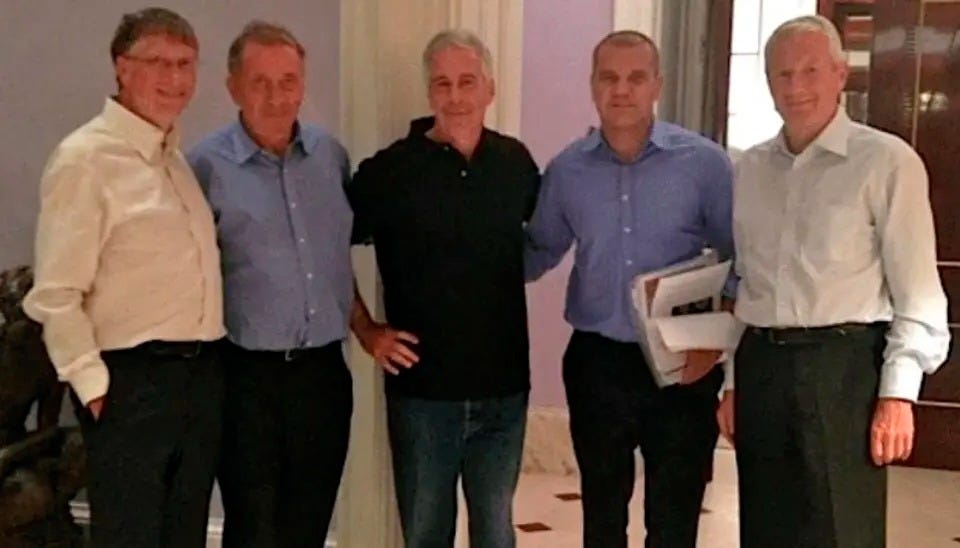
On May 9, 2013, Epstein updated Barak on his efforts to engage Putin through Jagland: “jagland is going to see putin in sochi, jagland asked that I make myself availble to meet with him sometine in june, to explain how russia can structure deals in order to encourage western investment.” Barak wrote back: “i know Jagland for long time. probably we have to talk about it.”
The next day, Epstein laid out his proposal for Putin, in a May 10 email to Jagland: “When sputnik was announced, the West was caught flatfooted. The same can now happen with Russia taking the lead in finance.” Epstein suggested that Putin was chasing the wrong modernization model, “copying silicon valley, looking for start ups, playing catch up to Microsoft . apple google and the like.”
In place of the “Skoltech” model, Epstein wanted to offer Putin an alternate path: Russia could “get out in front and leapfrog the global community by reinventing the financial system of the 21st century.”
The American financier proposed a framework for a new global currency: “A new form of money, on a world wide basis… much larger than any single project envisioned by any govt. and at its core not really that difficult to bring to fruition.”
Jagland had no clue what Epstein was talking about. “Hi Jeffrey, all this is not easy for me to explain to Putin,” he wrote. “You have to do it. My job is to get a meeting with him.”
Epstein dialed back the message for Putin, writing, “You can tell him that you and I are close, and that i advise Gates. this is confidential, . I would be happy to meet him , but for a minimum of two to three hours, not shorter.”
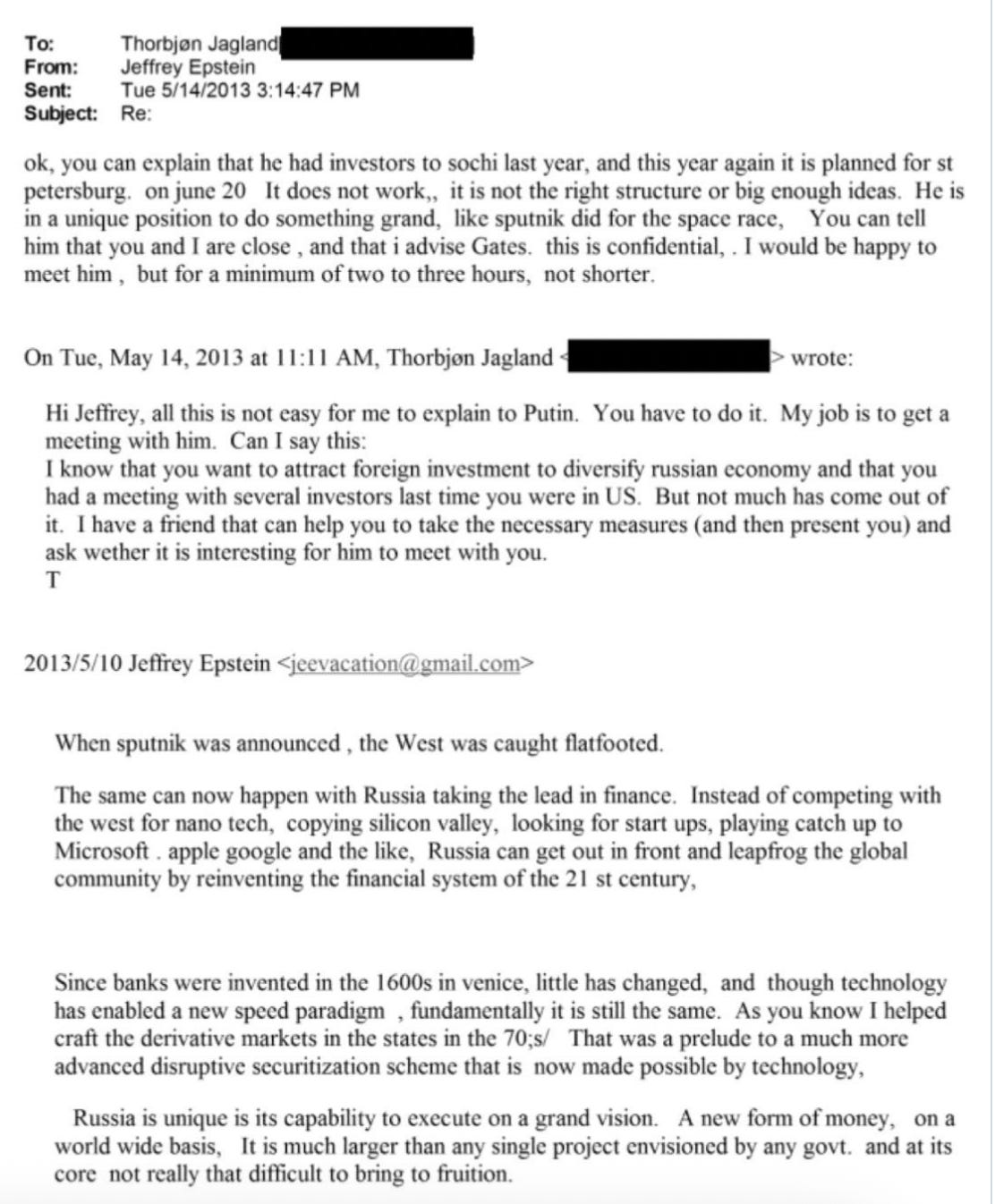
Jagland’s pitch to Putin appears to have worked. On May 22, 2013, Epstein claimed to Barak that he’d received, and rejected, an invitation to meet with Putin at the St. Petersburg International Economic Forum the next month: “Putin asked that i meet him in st petersburg the same time as his economic conference…i told him no, . If he wants to meet he will need to set aside real time and privacy.”
But, with close guidance from Epstein behind the scenes, Barak finally met Putin in late June 2013, during the St. Petersburg International Economic Forum.
“Access Remote Parts of Africa”
On August 6, 2013, the Kremlin extended Skolkovo’s funding through 2020, reversing the prior decision to gut the program. Barak and Epstein swiftly found an opportunity to profit from the Kremlin’s decision, making use of Epstein’s connection to the Gates Foundation.
Shortly after returning from St. Petersburg, Barak joined the advisory board of Parasight, an Israeli biotech company in the Skolkovo Innovation Center, which was developing technology to detect malaria in blood samples using computer vision AI. On August 10, 2013, Epstein connected Barak to Nikolic to get support for Parasight (now called Sight Diagnostics) from the Gates Foundation. Nikolic’s invitation to Barak appears in both the hacked dataset published by Distributed Denial of Secrets and the DOJ release last month, further corroborating the authenticity of the hacked Barak email cache.
Nikolic made plans to meet Barak in New York during the Clinton Global Initiative (CGI) in late September 2013. Nikolic wrote Barak: “I will be in NYC that whole week and I look forward to seeing you and catching up – most likely at Jeffrey’s – it is more interesting there than at CGI ;)”
Like most of the startups advised by Barak, Parasight’s roots were in Israeli military research units. Parasight co-founder Yossi Pollak is an alumnus of Talpiot, an elite Israeli Defense Forces science and technology program; Sarah Levy, a founding engineer and eventual chief technology officer, is also a Talpiot graduate and veteran of Unit 81, the secretive special technology unit of the Israeli Military Intelligence Directorate.
Barak’s point man on the Parasight project was his brother-in-law and business partner Doron Cohen, who served under Barak in Sayeret Matkal, the Israel Defense Forces’ elite special operations unit. Cohen and Barak were working together, in secret, on a security deal between Israel and the West African nation of Ivory Coast. In parallel, Epstein was shepherding the Gates Foundation into Ivory Coast, leveraging his close relationship with Nina Keita, the niece of President Alassane Ouattara; he tried to coordinate a meeting between Ouattara, Keita, and Gates on September 16, 2013, before the U.N. General Assembly that week.
Barak met Nikolic at Epstein’s mansion on September 20, 2013, and Barak introduced Nikolic to Parasight co-founder Daniel Levner via email. Levner later conveyed Nikolic’s feedback on next steps with the Gates Foundation: “Dr. Nikolic’s view is that the Gates Foundation’s driver in choosing technologies is the ability to access remote parts of Africa.”
Two months later, in November 2013, Barak received an email from Parasight’s founders asking for Vekselberg’s support for additional grant funding from Skolkovo. Barak discussed on the phone with Cohen, and one week later, the grant application was approved: Skolkovo pledged an additional $2.5 million to Parasight, on the condition that Parasight put $1.25 million of its own money into a new Russian entity.
Sight Diagnostics later developed portable malaria detection in collaboration with the U.S. Army Medical Research Directorate at Kisumu field station in Kenya, where the army runs programs for the U.S. Presidents’ Malaria Initiative, a USAID-led partner of the Gates Foundation. Drop Site was unable to confirm if Gates Foundation was directly involved in the Kenya trial. The Foundation, Nikolic, and Ponomarev did not respond to requests for comment.
“Designer Babies”
The files released by the U.S. Justice Department and House Oversight Committee have shown Epstein deeply preoccupied with theories of racial and genetic superiority. In an anonymous essay recovered from Epstein’s files, titled “Africa, parasites, intelligence,” the writer mused that “For Africa, the environmental factor is parasites—disease—known to exert a strong negative effect on intelligence.” “And what is special about Jewish intelligence?” the author asked. “Surely it is that it emerged in mercantile settings, natural home of numbers, logic and mathematics.”
Calculations about the long-term viability of the Israeli state, and anxieties about the demographics of its Jewish population, formed a backdrop to Epstein and Barak’s engagement with Putin. In the last years of Epstein’s life, Barak shared grave concerns with Epstein about Israel’s looming demographic crisis. During a dinner at Epstein’s New York mansion in February 2013, Barak told former Obama economic adviser Larry Summers that Israel needs to solve its Jewish population shortage “before it’s too late” and stop “the slippery slope to a one state nation … with an Arab majority.”
Barak believed the best hope for Israel’s future was allowing for conversion into Judaism to promote migration, by breaking the orthodox Rabbinate’s authority to define who is a “Jew.” “Open the gates for massive conversion to Judaism,” Barak said. “It’s a successful country, many will apply.”
Russian migration had been essential to Israel’s past success, and Barak hoped to repeat the pattern: “The Russian million changed Israel dramatically. Many would prefer to be Jews rather than Russians. Lots of young people, including women. We can easily absorb another million.” He proposed restricting migration from Arab and North African countries, telling Epstein and Summers, “We can control the quality much more effectively, much more than the founding fathers of Israel did. They took whatever came just to save people. Now, we can be more selective.”
As the relationship between the U.S. and Russia continued to deteriorate over the subsequent decade, Israel was forced to manage an increasingly tenuous balancing act between the two great powers. Epstein himself took a quiet interest in Russia’s growing conflict with Ukraine and NATO. On March 13, 2014, three days before a referendum on whether Crimea should join Russia, Epstein wrote to his broker at Deutsche Bank, “let’s play,” and instructed her to place a $250,000 bet against the Russian ruble. By the end of the year, the ruble had lost nearly 50 percent of its value relative to the U.S. dollar.
After the referendum, on March 18, Epstein messaged Ariane de Rothschild and her senior advisor Olivier Colom, a former aide to Nicolas Sarkozy and expert in the African mining industry: “ukraine upheaval should provide many opportunites , many.”
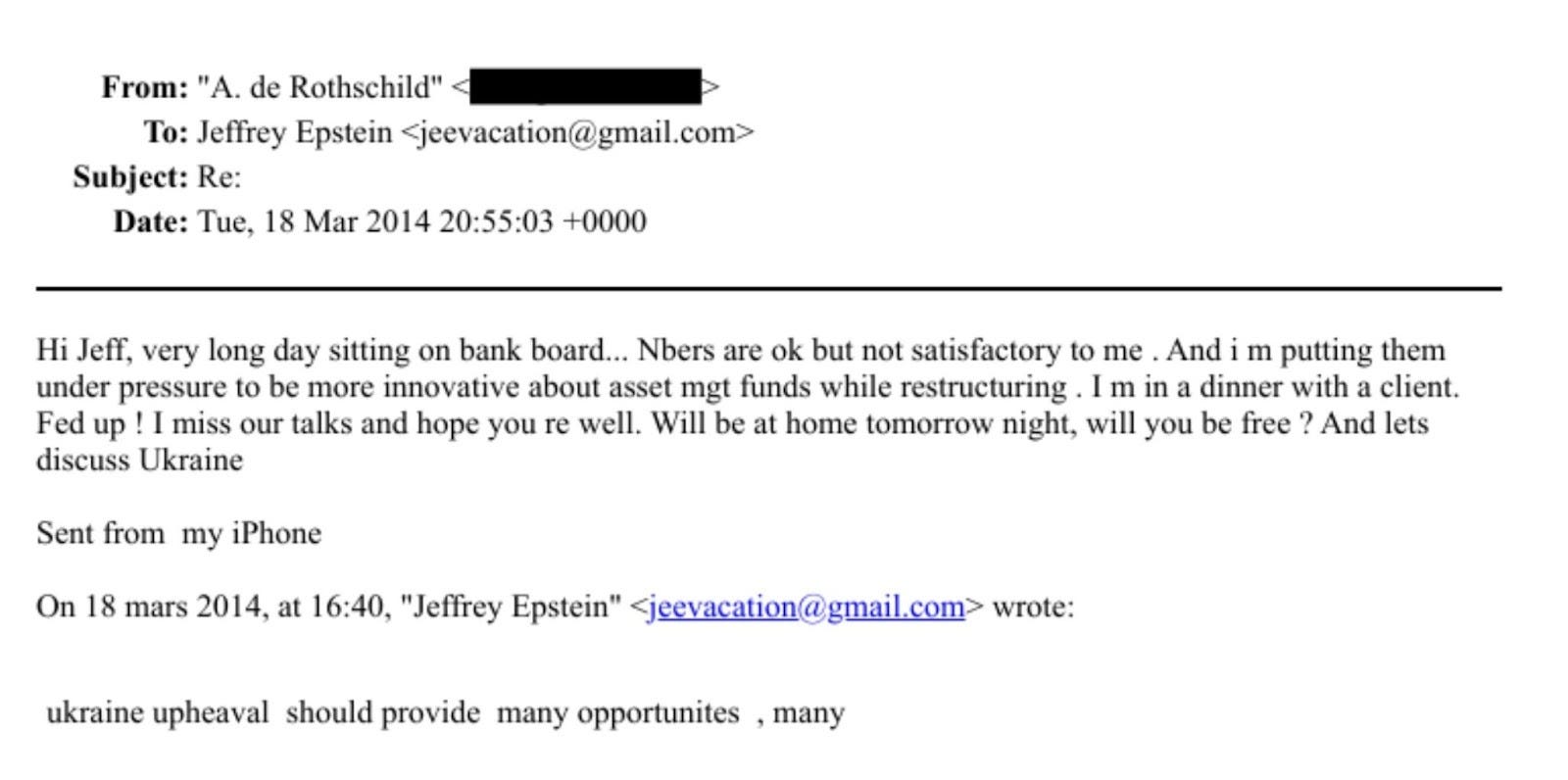
On March 20, 2014, Ilya Ponomarev was the sole “no” vote in the Duma on Russia’s annexation of Crimea. He was vilified in Russian state media, and placed on a billboard in the center of Moscow which labelled him as a “national traitor.” Ponomarev fled to the United States soon after.
The next year, in June 2015, Epstein asked for Nikolic’s help obtaining asylum for a Russian woman whose name is redacted in the emails. Nikolic offered to introduce her to Ponomarev. “He knows most of leadership of LGBT community in Russia and has helped such application for asylum in USA in past,” Nikolic wrote, adding, “He will help.”
By this time, Nikolic had departed the Gates Foundation, and was helping steer major private capital into the gene-editing boom. In August 2015, Epstein’s Deutsche Bank banker, Paul Morris, forwarded a write-up on the CRISPR startup Editas Medicine, highlighting a $120 million funding round led by Nikolic.
In the final year before his death, Epstein supported a bio-lab in Ukraine for the production of “designer babies,” led by hacker Bryan Bishop. On July 21, 2018, Epstein wrote to Bishop, “i have no issue with investing the problem is only if i am seen to lead.” Bishop wrote back, “I have always envisioned there would be anonymity requirements about babies– we can’t publicly identify who these are or their parents or benefactors, it would brand the child as (essentially, and sadly) a freak for life in the media.”
Bishop planned to brainstorm with Epstein about ways to protect the anonymity of all persons involved. “I had always assumed the investor would need absolute anonymity, for these kinds of products,” Bishop wrote. “So the financial structure needs to be designed with these details in mind.”
After Russia’s invasion of Ukraine in 2022, Russian state media began spreading a “conspiracy theory” that the United States was operating secret military biological experiments to create “monster” soldiers in Ukraine. U.S. and Ukrainian officials categorically denied the allegations.
As the war unfolded, Ilya Ponomarev became a leader of the Freedom of Russia Legion, a volunteer militia of Russian defectors fighting for Ukraine, and joined the Congress of People’s Deputies, a shadow parliament of Russian opposition figures.
In 2019, a redacted sender wrote to Epstein regarding another vocal critic of Putin, Ukrainian President Volodmyr Zelenskyy. “Zelensky looking for help,” the person wrote, “Putin dismissive, saying he is run by Israelis.” According to Epstein’s calendar, he planned to stay at the Hyatt Regency in Kyiv in February, one month before the first round of Ukraine’s presidential elections. In another message, Epstein received a link to a May 2019 New York Times article on Ihor Kolomoisky, Zelenskyy’s Ukrainian-born, Israeli backer. Epstein wrote back, “I’m following the situation. Lot of fun.”
 | A guest post by
|
Wow. You've done some fascinating reporting. I had no idea Epstein was involved in so many technological issues, but I'm not surprised that he was interested in genetics and "designer" babies. It appears that a bunch of the silicon valley tech bros want to increase their lifespan and level of intelligence through drugs and/or genetic manipulations.
sounds like some techlord transhuman stuff here. same disease of the ego.