

Peace talks continue as U.S. and Iran trade strikes; Netanyahu escalates in Lebanon; China ships 15,000 tons of rice to Cuba
Drop Site Daily: May 26, 2026

U.S. forces strike vessels near Bandar Abbas, Iran hits U.S. aircraft. Iran sends top delegation to Doha. Iranian media: $24B in frozen assets must be released as part of deal. Secretary of State Marco Rubio says Iran deal could take “a few days.” Iran says it will not charge tolls in Hormuz. President Donald Trump demands countries in Iran negotiations sign Abraham Accords. At least 11 killed in Israeli strike on Lebanon on Tuesday. Israel orders displacement of entire city of Tyre and at least 10 other southern villages. Israeli Prime Minister Benjamin Netanyahu signals major escalation in Lebanon. Eight Palestinians killed early Tuesday. French flotilla activist offers testimony of sexual assault and beatings by Israeli soldiers while detained. Canada condemns treatment of flotilla participants as “appalling.” Texas runoffs on Tuesday pit Trump-backed Ken Paxton against Sen. John Cornyn. ICE pepper-sprays Sen. Andy Kim and protesters outside Newark detention center. Maine Sen. Susan Collins photographed alongside antisemitic far-right militia. Former Trump White House Latin American deputy exercising control over Venezuela’s president and economy, report says. Pope Leo XIV releases 42,000-word encyclical covering humanity’s struggle with technology. Bolivian president offers to halve his salary and cabinet pay amid protests. Russia warns of systematic strikes on Kyiv defense facilities, urges foreign citizens to leave. RSF drone strikes on markets in North Darfur kill at least 21 civilians over two days. Attacks on Ebola treatment facilities in eastern Congo force dozens of patients to flee. Suicide car bomb kills at least 24 in Pakistan’s Balochistan. Xi hails “unbreakable” China-Pakistan friendship. China ships first 15,000 tons of rice to Cuba. Turkish police ordered to remove opposition party leadership from headquarters. Bangladesh intensifies border patrols amid concerns India is illegally forcing people across the frontier. At least 400 Iraqi prisoners died in 2025, according to human rights group.
FROM DROP SITE:
Israel Has Physically Divided Gaza With Over 25 Kilometers of Earthen Barriers
Israel Is on a Killing Spree of Paramedics and Rescue Workers in Lebanon
Iranian Official Outlines Latest Proposal to End the U.S. War as Trump Weighs New Strikes
VIDEO: Israel PANICS And Withdraws From Two Bases In Lebanon
Drop Site is now live on WhatsApp. Get our latest reporting, podcasts, and breaking news, delivered directly. Join the channel here.
This is Drop Site Daily, our free daily news recap. We send it Monday through Friday. Today’s edition is being sent to more than 750,000 subscribers. Help us grow that number by forwarding and recommending this newsletter.
🛒 Get your “Drop [Site] News/Not Bombs” Hoodie here:
Iran and Ceasefire
U.S. forces strike vessels near Bandar Abbas, Iran hits U.S. aircraft: U.S. CENTCOM spokesperson Captain Tim Hawkins confirmed that American forces had struck vessels near the southern Iranian port city of Bandar Abbas on Monday in “self-defense strikes.” Hawkins said in a statement that the strikes targeted missile launch sites and Iranian boats attempting to place mines, saying the strikes were conducted “to protect our troops from threats posed by Iranian forces.” In Iran, the news website Tabnak reported that four had been killed in American strikes, according to the AP.
Iran’s Islamic Revolutionary Guard Corps (IRGC) said it shot down a MQ-9 Reaper drone that entered Iranian airspace. The IRGC forces “also fired upon an RQ-4 drone and an intruding F-35 fighter jet,” a statement said, without specifying when the incidents took place.
Negotiation updates:
Iran sends top delegation to Doha: Iran’s Foreign Minister Abbas Araghchi, Parliament Speaker Mohammad Bagher Ghalibaf, and Central Bank Governor Abdolnaser Hemmati traveled to Doha on Monday evening for talks on a potential deal to end the U.S.-Israel war on Iran.
Iranian media: $24B in frozen assets must be released as part of deal: A source close to Iran’s negotiating team told the Tasnim news agency that $24 billion of frozen Iranian assets must be released in any potential deal with the United States. The source said Tehran’s position is that half of the amount—$12 billion—must be released when a memorandum of understanding is announced and the remaining released within 60 days.
Iranian official outlines Tehran’s terms to end the war: A senior Iranian official told Drop Site on Friday that Tehran had put forward a set of terms as a framework for a deal, including the provisional reopening of the Strait of Hormuz—contingent on an end to the U.S. blockade of Iranian ports, the release of billions of dollars in frozen Iranian assets, and a plan to compensate Iran for damages incurred in the war. The official also stated that the Iranian framework would require an agreement to permanently end the war first, followed by immediate negotiations to reach a deal over the nuclear program. Read the full report by Jeremy Scahill and Murtaza Hussain here.
Rubio says Iran deal could take “a few days”: Secretary of State Marco Rubio said Tuesday that a potential deal to end the U.S.-Israel war on Iran could “take a few days.” During a visit to India, Rubio told reporters, “There were some talks going on in Qatar today, so we’ll see if we can make progress. I think it’s a lot of talking back and forth going on about specific language in the initial document, so it’ll take a few days.” He reiterated the American position that the Strait of Hormuz must remain open, calling its closure “unlawful, illegal, and unsustainable for the world,” and adding that it “will be open one way or the other.”
Khamenei says U.S. Gulf allies cannot “shield” American bases: Iranian Supreme Leader Mojtaba Khamenei marked Eid al-Adha with a written statement warning that regional countries “will no longer serve as shields for American bases.” He added that the conflict would perhaps push Gulf states away from their American allies. “Regional countries have now concluded that the military presence of the U.S. has not only failed to ensure their lasting security, but relying on America for security has been an unrealistic and ineffective notion,” Khamenei said in the statement carried on Iranian state television.
Iran says it will not charge tolls in Hormuz: Esmaeil Baghaei, a spokesperson for Iran’s Ministry of Foreign Affairs, said on Monday that the state will not impose tolls on ships using the Strait of Hormuz, but that any charges will be for maritime services and “environmental protection” measures in the Persian Gulf and Gulf of Oman. In the same press conference, he confirmed earlier reporting that Iranian negotiators had told their U.S. counterparts that “ending hostile action on all fronts, including Lebanon” was a necessary condition for an agreement. He said negotiations with the U.S. had been fruitful: “Most issues on the table have been agreed upon.”
Trump demands countries in Iran negotiations sign Abraham Accords: President Donald Trump posted on Truth Social Monday demanding that all countries involved in Iran negotiations simultaneously sign the Abraham Accords as a prerequisite for any deal, naming Saudi Arabia, Qatar, Pakistan, Turkey, Egypt, Jordan, and Bahrain. (The United Arab Emirates and Bahrain are already members, which he noted; Egypt and Jordan signed peace deals with Israel decades ago.) Trump warned that those who refuse “should not be part of this Deal, in that it shows bad intention.” He said it would be “special” if Iran signed onto the Abraham Accords. “It may be possible,” he conceded, “that one or two have a reason for not doing so, and that will be accepted, but most should be ready, willing, and able to make this Settlement with Iran a far more historic event than it would, otherwise, be.” Foreign Ministry spokesman Esmaeil Baghaei dismissed the offer, saying that “normalization” in the form of these accords “cannot grant legitimacy to an illegitimate entity, especially one that has committed genocide and violated international law.”
Trump signals flexibility on Iran’s enriched uranium: President Donald Trump appeared on Monday to soften his previous demand that Iran surrender its stockpile of highly enriched uranium, outlining two options he claimed were acceptable to the United States in a Truth Social post: Iran either hands over its nuclear material to the United States to be destroyed, or—his stated preference—it is destroyed inside Iran in coordination with the Islamic Republic under the witness of the Atomic Energy Commission or equivalent body. The post marks a shift from Trump’s earlier position that Iran could not “keep” its enriched uranium unconditionally, and tracks with what Drop Site News first reported last week—that a senior Iranian official said Iran could offer dilution of uranium enriched above 20% inside Iran with the participation of mediators—though a senior Iranian diplomat confirmed to ISNA on Monday that the current memorandum of understanding draft contains no nuclear commitments whatsoever, with Iran’s position being that nuclear issues come only after the first-phase MOU is signed and confidence-building measures are implemented.
Qatar denies offering $12 billion to Iran to secure deal: Qatar’s Foreign Ministry spokesperson Dr. Majed Al Ansari rejected on Monday earlier reports that Doha offered $12 billion to Iran to secure a U.S.-Iran agreement, calling the claims “utterly baseless” and accusing unnamed parties of circulating them to “sabotage the deal and undermine ongoing diplomatic efforts,” after Amwaj Media and Iran International reported that approximately $12 billion in Iranian frozen assets held in Qatar, Iraq, and Turkey were central to the negotiations. The distinction Qatar appears to be drawing is between facilitating access to Iranian funds already frozen in Qatari banks and actively offering money to Iran.
Iran and Oman hold talks on Hormuz: Iran’s Deputy Foreign Minister for International Affairs Kazem Gharibabadi said Tehran and Muscat held talks on joint governance and security coordination over passage through the Strait of Hormuz on Sunday, according to Fars News, with discussions focused on the “security and national sovereignty” of the strait’s coastal states
Separately, the Islamic Revolutionary Guard Corps Navy announced that 33 vessels, including oil tankers, container ships, and other commercial ships, passed through the strait over the course of 24 hours on Sunday. The vessels reportedly obtained permission and received security-related coordination from the IRGC before doing so.
Iran’s president orders internet access restored to pre-war levels: Iranian President Masoud Pezeshkian has ordered the restoration of internet access to pre-January 2026 levels, according to a source in Iran’s Ministry of Communications cited by Fars News. This follows months of heavy restrictions imposed during the U.S. and Israeli campaign against the country.
Iran executes man on espionage charges: Iran executed another man on charges of alleged espionage and intelligence cooperation with Israel, the Tasnim news agency reported on Tuesday.
Lebanon
Casualty count: At least 3,213 people have been killed, and 9,737 wounded in Israeli attacks on Lebanon since March 2, according to the Lebanese Health Ministry.
Israeli attacks on Tuesday: At least 11 killed in Israeli strike; displacement order for Nabatieh: An Israeli airstrike on the town of Mashghara early Tuesday in the western Bekaa Valley killed at least 11 people, including two girls and a woman, and wounded 15 others, according to Lebanon’s Health Ministry. The ministry said the toll remains preliminary as rescue teams continue clearing rubble at the strike site. The Israeli military also issued Tuesday a forced displacement order for all residents of Nabatieh in southern Lebanon, demanding they move north of the Zahrani River immediately ahead of planned strikes and ground operations, Al Jazeera’s Zeina Khodr reported.
Attacks Sunday and Monday:
Israeli strikes kill nine across southern Lebanon on Monday: Israeli drone strikes killed four people and wounded others across southern Lebanon on Monday, according to local media reports, including the son of a former president of the Wazzani municipal council, and two brothers killed in a strike on the Nabatieh-Jarmaq road. A fourth person was killed and another wounded in a separate strike on Shehabieh. Evening strikes on Mashghara in the western Bekaa killed at least 5 and wounded 11 others, including children, according to Press TV. Additional Israeli strikes on Monday also hit the Rashidieh Palestinian refugee camp near Tyre, targeting a water well supplying the northern section of the camp and a solar power system, according to L’Orient Today.
Israel orders displacement of entire city of Tyre and at least 10 other southern villages: Israel issued forced displacement orders Monday for the entire city of Tyre and at least 10 villages across the Nabatieh and Jezzine districts, ordering residents to move at least 1,000 meters away ahead of expected strikes.
Israeli forces escalate strikes across central and southern Lebanon, with more than 40 attacks reported Sunday: Israeli forces dramatically escalated airstrikes across central and southern Lebanon on Sunday, with more than 40 strikes reported since morning, Press TV correspondent Hadi Hoteit reported from the ground. Hoteit reported fresh strikes on Ansar, Al-Kharayb, and Kawthariyat Arroz—villages connecting central Nabatieh to the coast that journalists had been using as access routes—as the Israeli army issued mass warnings of bombings across the entire Nabatieh area toward the coast.
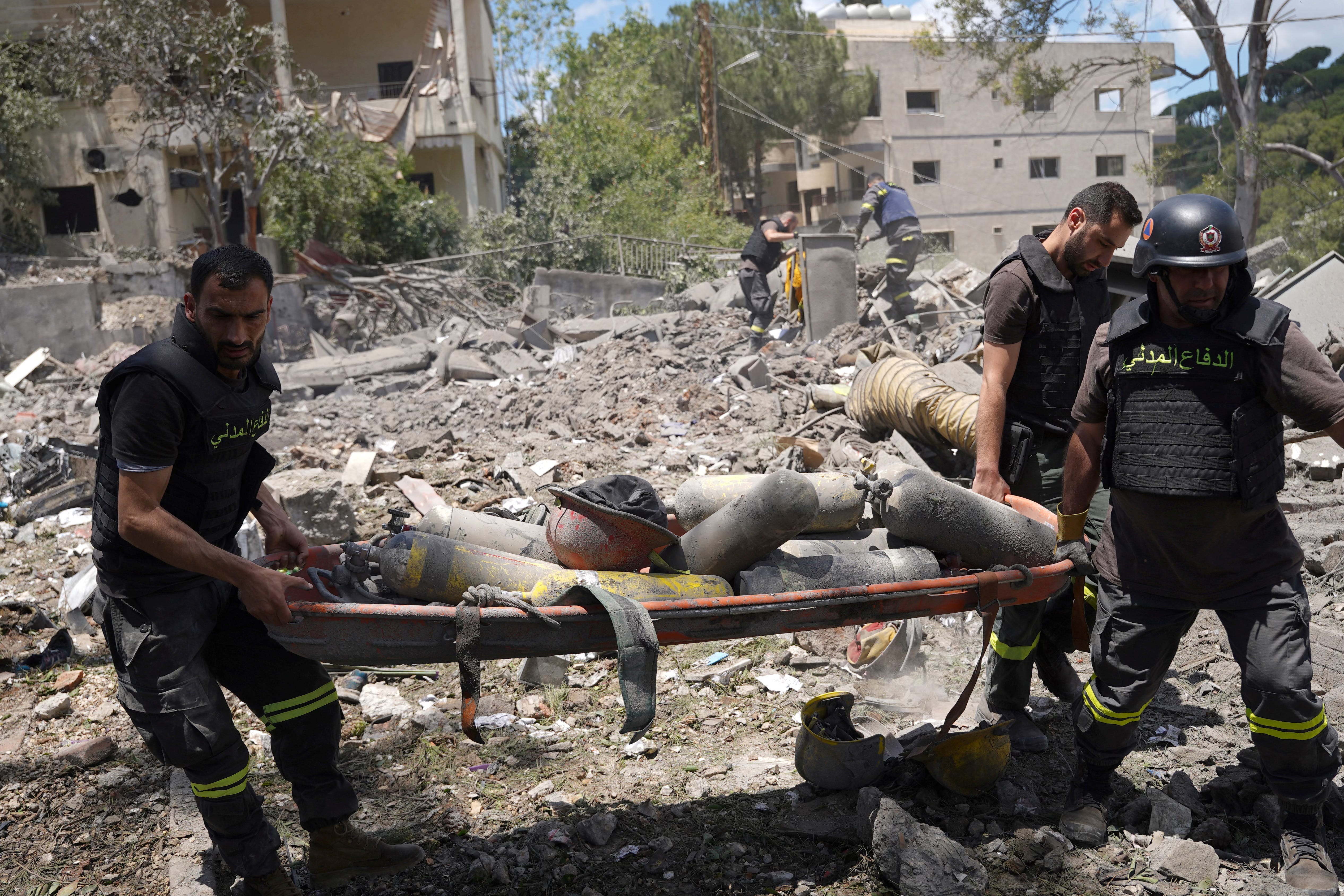
Paramedic killed in Arabsalim: A double-tap strike targeted first responders rushing to aid the wounded in Arabsalim on Sunday, killing one, according to Cradle Media. Attacks on Arabsalim also wounded 10 others, including two paramedics from the Islamic Health Authority and four medics from the Al-Risala Scout Association, according to Lebanon’s Health Ministry. In total, more than 120 health care workers have been killed and over 260 wounded in Israeli airstrikes across Lebanon since March 2. Journalist Katrine Dige Houmøller reported for Drop Site on this Israeli campaign of targeting paramedics and rescue workers in Lebanon. Read the full report here.
Hezbollah drone kills Israeli soldier in southern Lebanon: A Hezbollah explosive drone struck an Israeli military armored personnel carrier near the Christian village of Debl in southern Lebanon on Sunday, killing a sergeant in the 601st Combat Engineering Battalion of the Iron Tracks Brigade and seriously wounding another soldier, according to Ynet and Israeli military reporting. A senior Hezbollah official, Wafiq Safa, later recounted the details of the operation to The Grayzone, saying that the group deliberately targeted the Israeli brigade commander after obtaining intelligence on his location, and that its low-cost FPV drones have exposed Israel’s inability to counter a simple weapon. The officer killed in Debl is the seventh Israeli soldier killed by an explosive drone in Lebanon since a ceasefire was agreed to on April 16.
Netanyahu signals major escalation in Lebanon: Israeli Prime Minister Benjamin Netanyahu and Defense Minister Israel Katz held talks Monday and are leaning toward significantly expanding military attacks on southern Lebanon, according to Israel’s Channel 14. The Israeli military has reportedly prepared a broad strike plan targeting buildings and infrastructure it claims Hezbollah uses. Chief of Staff Eyal Zamir proposed striking buildings in Beirut. In a video on Telegram, Netanyahu told the Israeli public that “We are at war with Hezbollah, and we will intensify our strikes,” and relayed that he had instructed the Israeli military to “crush” the group, and not to “take its foot off the gas.” “On the contrary, I said to step on the gas even more,” he said.
Separately on Monday, a report from Axios indicated that the Trump administration supports an escalation in the country, with a source quoted in the article claiming that Hezbollah “ignored repeated requests to stop firing.” According to that source, the administration blames Hezbollah entirely for the country’s conflict, despite continued Israeli strikes in Lebanon, and says that Israel “will never be required to passively absorb attacks” as a result of a ceasefire agreement.
Hezbollah chief vows “third liberation” of Lebanon: Hezbollah Secretary General Sheikh Naim Qassem delivered a speech on Resistance and Liberation Day on Sunday, pledging the group’s continued resistance to Israel’s invasion and rejecting calls for disarmament, which he called “an Israeli project that must be reversed.” Hezbollah’s arms, Qassem said, “will remain in our hands until the Lebanese state is capable of carrying out its duties.” “The Lebanese authority tells us: help us strip you of your weapons so that Israel can later enter, kill you, and displace your people,” Qassem remarked about the Lebanese government, which he also accused of making “continuous concessions” to Israel and the United States. Qassem He also called for the release of 41 Shia scholars imprisoned by the Bahraini government over alleged ties to Iran.
Palestine
Casualty count: Over the last 24 hours, six Palestinians were killed—two in new attacks and four recovered from under the rubble following earlier attacks—and 34 were injured across Gaza. At least 20 Palestinians were killed in Israeli attacks since Friday. The total recorded death toll since October 7, 2023 has risen to 72,803 killed, with 172,855 injured. Since October 11, the first full day of the so-called ceasefire, Israel has killed at least 906 Palestinians in Gaza and wounded 2,747, while 781 bodies have been recovered from under the rubble, according to the Palestinian Ministry of Health.
Eight Palestinians killed early Tuesday: At least eight Palestinians were killed in Israeli attacks across the Gaza Strip on Tuesday morning, according to WAFA. In central Gaza, five people were killed in the Al-Maghazi refugee camp after an Israeli-backed militia attempted to enter the camp and was confronted by residents, after which Israel struck the area, according to local reports. The incident was similar to another in April when at least 10 Palestinians were killed and dozens wounded when Israel conducted airstrikes on the same camp following an attack by an Israeli-backed Palestinian militia. Read Drop Site’s coverage of that attack here. In southern Gaza, two more Palestinians were killed when an Israeli drone strike targeted a vehicle near the Abu Alaa roundabout west of Khan Younis. A 15-year-old girl also died from wounds sustained in an Israeli strike on the Al-Mawasi area west of Khan Younis on Monday.
Two killed in Gaza on Monday: An Israeli strike on a camp in Khan Younis killed two Palestinians on Monday, including a 6-year-old girl and a woman. Seventeen more were wounded in this attack, according to Palestine Online, including a one-month-old infant, whose foot was reportedly severed. Additional strikes and artillery shelling were described in the evening in Al-Nuseirat and east of Gaza City.
Five Palestinians killed in Israeli attacks across Gaza on Sunday: Five Palestinians were killed Sunday in Israeli attacks across Gaza, including a family of three in an Israeli bombardment of a residential apartment in Nuseirat refugee camp in central Gaza, according to Al-Jazeera. One Palestinian was also killed by Israeli gunfire in northern Gaza, and the body of an eight-year-old boy was recovered inside a tent in the Al-Tawam area in northwestern Gaza after he went missing Saturday following Israeli shelling.
Israel has built 25 kilometers of earthen barriers inside Gaza since “ceasefire”: Forensic Architecture, drawing on satellite imagery and other data, has found that Israel has constructed more than 25 kilometers of earthen berms physically dividing Gaza since the October 2025 ceasefire agreement—with much of the barrier running west of the “yellow line” and deeper into Palestinian territory. Israel’s military also operates 38 military bases east of the line, which it has fortified by clearing rubble, paving roads, and building higher berms in the areas, which it uses as firing positions against Palestinians in the western part of the strip. Israel, which was supposed to control 53% of Gaza under the ceasefire terms, now effectively controls over 60% of the territory. Read the latest report from Drop Site and Forensic Architecture here.
Trump’s Board is rewriting the Gaza agreement to force a surrender of the Palestinian cause: More than seven months after Hamas and Israel reached a ceasefire agreement intended to end the war in Gaza, senior Palestinian resistance told Drop Site News that President Donald Trump’s “Board of Peace” is rewriting the October agreement to entrench Israeli control over Gaza and pressure Palestinians to abandon their national cause. Senior Hamas negotiator Basem Naim said the movement has fulfilled its obligations under the ceasefire, while Israel maintains its “continuous killing of Palestinians,” is blocking reconstruction materials, and expanding military operations. The resistance leaders rejected efforts to make Palestinian disarmament the central condition for reconstruction or political progress in Gaza with Naim charging that the “High Representative for Gaza” Nickolay Mladenov is attempting to manufacture public pressure on Hamas after failing to achieve a breakthrough in negotiations. Read the full report from Jeremy Scahill and Jawa Ahmad here.
Gaza Health Ministry warns critical medicine shortages threaten thousands of patients: Gaza’s Health Ministry issued an urgent warning Sunday about a critical depletion of medicines and medical supplies which could threaten the lives of thousands of patients, including those of 250 kidney patients at risk of losing dialysis sessions due to a shortage of Bibag solution, 11,000 diabetic patients whose conditions could worsen considerably as a result of an insulin shortage, and 110 hemophilia patients already left in compounding daily pain without VACTOR treatment. The ministry issued an urgent appeal to all relevant parties to immediately replenish drug stockpiles, as Israel continues to block essential food and medical aid 228 days into the ceasefire. American nurse Ellie Burgos, who is currently volunteering at a hospital in Gaza, told Sahat News that “People are still dying,” and the only difference is that they are dying more “slowly” now. Her interview with Sahat is available here.
French flotilla activist offers testimony of sexual assault and beatings by Israeli soldiers while detained: Meriem Hadjal, a French activist who was detained as part of Israel’s mass detention of participants in the Global Sumud Flotilla, spoke to French public broadcaster France Info about her experience in detention. Hajdal said that she and other detainees were stripped of warm clothing and taken individually into a dark shipping container, where she recalls being repeatedly groped, slapped, beaten, kneed in the ribs, and sexually assaulted by multiple Israeli soldiers. Hadjal’s account adds to other accounts of similar treatment in Israeli custody, with the Flotilla’s organizers reporting that at least 15 of the 480 detained activists recounted incidents of sexual assault at the hands of Israeli officials.
Canada condemns treatment of flotilla participants as “appalling”: Canadian Prime Minister Mark Carney called the treatment of flotilla participants detained by Israel “appalling” and demanded an independent investigation into the mistreatment of these activists during a phone call on Monday with Israeli President Isaac Herzog. Canadian Foreign Affairs Minister Anita Anand separately told her Israeli counterpart, Gideon Saar, that Ottawa would provide Israel with evidence of the mistreatment of Canadian citizens aboard the flotilla. She said denying Canadian citizens consular access during detention “violates the Vienna Convention and must never happen again.” Carney, unlike his counterparts in France, Italy, and Poland, did not announce any new forms of pressure on or sanctions against Israel’s government; the latter three recently announced punitive measures including sanctions and a ban on the entry of Israeli minister Ben Gvir to their territories in response to a video of the minister taunting and abusing flotilla detainees.
U.S. News
By Julian Andreone, with Ryan Grim. Have a tip on Capitol Hill? Email Andreone at Julian@dropsitenews.com.
Texas runoffs Tuesday pit Trump-backed Ken Paxton against Senator John Cornyn: Republican Sen. John Cornyn of Texas faces a high-stakes runoff Tuesday against Attorney General Ken Paxton, who narrowly finished behind Cornyn in the March primary and received the president’s backing last week. The winner will face former State Rep. and Democratic Nominee James Talarico in November.
Tuesday’s ballot also features a generational clash in Houston between 11-term incumbent Democrat Al Green, 78, and Rep. Christian Menefee, 38, who has received considerable support from the crypto lobby.
In the 35th Congressional District, national Democrats are backing Bexar County sheriff’s deputy Johnny Garcia in a runoff against left-wing activist Maureen Galindo, who has received nearly $900,000 from a secretive super PAC with Republican ties after making antisemitic remarks.
Rubio aide Mike Needham promoted to deputy national security adviser: Mike Needham, a longtime aide to Secretary of State Marco Rubio who most recently served as his State Department counselor, has been promoted to assistant to the president and deputy national security adviser, replacing Robert Gabriel, according to Axios. Because Rubio also serves as national security adviser (having replaced Tulsi Gabbard over the weekend), Needham’s move to the White House keeps him in close contact with Rubio, who said in a statement that Needham “will continue to implement the President’s America First agenda.”
ICE pepper sprays Sen. Andy Kim and protesters outside Newark detention center: Sen. Andy Kim (D-N.J.) was pepper-sprayed by Immigration and Customs Enforcement officers on Monday while joining Gov. Mikie Sherrill and several House Democrats for an oversight visit to Delaney Hall detention center in Newark, where around 300 migrants are holding a hunger and work strike over conditions, including lack of due process, poor food, and mistreatment. Kim said ICE responded to the demonstration by deploying an armored vehicle and armed agents who tackled protesters and fired pepper balls into the crowd.
Maine Sen. Susan Collins photographed alongside antisemitic far-right militia: Republican Sen. Susan Collins of Maine posted a Memorial Day message Monday featuring a photo alongside members of the “Maine Militia,” an armed, far-right paramilitary group, Drop Site’s Julian Andreone reported. The militia has previously described the MAGA movement as a “Jewish psyop” and has written that it does not “worship Blacks and Jews.”
Progressive challenger with AI research background takes on AIPAC-backed Rep. Auchincloss in Massachusetts primary: Rep. Jake Auchincloss of Massachusetts faces a primary challenge from Evan Poulos, a computational political scientist and former Scale AI contractor whose platform centers on Medicare for All, universal basic income, and corporate taxes on automation—and who has criticized Auchincloss for accepting AIPAC money, voting to send weapons to Israel, and supporting expanded surveillance authorities. Poulos has raised little money against Auchincloss’s war chest ahead of the state’s September primary.
Pro-Israel donors using new fundraising vehicle to covertly back Democratic candidates in contested primaries: Pro-Israel donors aligned with AIPAC appear to be channeling money to Democratic primary candidates through a newly formed umbrella group called the Better Blue Fund, which has raised nearly $300,000 in under two months from longtime AIPAC donors—including a $31,500 contribution from an investor who gave $250,000 to Democratic Majority for Israel last cycle. Better Blue Fund is backing eight candidates facing progressive challengers over their support for military aid to Israel. More on “Better Blue Fund” from The Lever, here.
Former White House official exercising control over Venezuela’s president and economy, report says: Mauricio Claver-Carone, the Cuban-American operative who helped oversee the Trump administration’s hardline Latin America policies during his first and second terms, is reportedly functioning as a de facto gatekeeper over Venezuela’s post-Maduro government despite holding no official title, according to The Grayzone and the Washington Post. A source close to Trump and Rubio confirmed the report to Drop Site. The Grayzone’s sources said that President Delcy Rodríguez “is taking instructions” from Claver-Carone and that he is “calling the shots on private sector economic positions” while raising capital for his Miami-based Lara Fund investment firm.
Other International News
Pope Leo XIV releases 42,000-word encyclical covering humanity’s struggle with technology: The Chicago-born pope released his first papal encyclical calling out the dangers of artificial intelligence and urging the safeguarding of the human person. “We must remember that humanity flourishes not despite limitations, but often through them,” the pope writes. The “technological transformation” of our age, he says, is having a profound impact on both truth—through the ability of AI to mimic and distort reality and shape communications—and conditions of work, where the pope urged an economy that treats humans with dignity. The encyclical, Magnifica Humanitas, is here.
Bolivian president offers to halve his salary and cabinet pay amid protests: Bolivian President Rodrigo Paz Pereira announced Monday he would cut his salary and those of his cabinet ministers in half as a gesture of “commitment to the country,” amid a growing political crisis in the country now entering its fourth week, with protests and roadblocks causing severe shortages of food, fuel, and medicine in La Paz and El Alto. Protesters, subject to violent repression, are pushing Paz’s centrist government to roll back austerity measures, restore a fuel subsidy that had kept prices at 2006 levels, and address rising living costs. As of Sunday evening, the protests were ongoing, with tens of thousands of indigenous Kataristas marching from El Alto to La Paz, according to Drop Site contributor Joseph Bouchard.
Bolivia’s Senate votes to lift limits on martial law and lethal force: Bolivia’s Senate voted Sunday to overturn legal limits on the government’s ability to declare martial law and authorize lethal force by security forces, according to local reports, fueling fears that the government in La Paz could declare a state of emergency.
Bolivian vice president breaks with president: Bolivian Vice President Edman Lara publicly broke with Paz on Sunday, demanding an end to what he characterized as government repression during the protests, after a protester was allegedly killed during a state operation to forcibly clear roadblocks. In a public statement, Lara accused the government of responding to “hunger, fear, and the exhaustion of the people” with “repression and arrest warrants.” Paz’s government has denied responsibility for the killing.
Russia warns of systematic strikes on Kyiv defense facilities, urges foreign citizens to leave: Russia is planning a “series of systematic strikes” on defense industrial facilities in Kyiv where drones are “designed, manufactured, programmed, and prepared for use,” Russia’s Foreign Ministry warned, while urging foreign citizens to leave the capital. Last week, a Ukrainian drone strike on a student dormitory in Starobilsk in the occupied Luhansk region killed at least 18 and wounded 42. Ukraine’s military denied targeting civilians, saying it had struck an elite drone command unit. In strikes on Kyiv on Sunday, four people were reportedly killed, and 60 wounded. Russia said it had used an Oreshnik hypersonic ballistic missile, marking the third use of the nuclear-capable weapon in the four-year war.
RSF drone strikes on markets in North Darfur kill at least 21 civilians over two days: Rapid Support Forces drone strikes on markets in the North Darfur towns of Al-Tina and Kornoi killed at least 21 civilians and wounded dozens, local sources told Sudan Tribune. That number includes 14 killed Sunday in Al-Tina—a key commercial and humanitarian corridor on the Chad border—and five killed Monday in Kornoi. The strikes coincide with reports of a major RSF buildup in Saraf Omra, Kebkabiya, El Geneina, and Kulbus that observers believe signal preparation for ground assaults on army positions along the border with Chad.
Attacks on Ebola treatment facilities in eastern Congo force dozens of patients to flee: At least three attacks on health facilities treating Ebola patients have occurred in the northeastern Democratic Republic of the Congo province of Ituri since the weekend, including two strikes on the Mongbwalu General Referral Hospital that caused 25 patients to flee. The attackers are reportedly motivated by a desire for the hospitals to release the bodies of deceased Ebola patients for burial—unsafe given that the virus remains transmissible after death—or by suspicion or doubt about the virus. The outbreak of the rare Bundibugyo strain of Ebola is the third-largest on record, with the World Health Organization now reporting more than 900 suspected cases and 220 suspected deaths.
Tensions between Taiwan and China escalate in the Taiwan Strait: Taiwan’s Ministry of National Defense said Tuesday it detected 29 Chinese aircraft—including fighter jets—and seven warships operating around the island as part of the second “joint combat readiness patrol” conducted by China within the span of a week. In response to the encroachment, Taiwan’s National Security Council Secretary-General Joseph Wu accused Beijing of being “the sole source of instability in the Indo-Pacific.” Last week, after Trump’s visit to China, the U.S. paused a $14 billion arms sale to Taiwan, reportedly to conserve munitions for its war on Iran.
Suicide car bomb kills at least 24 in Pakistan’s Balochistan: A suicide car bomb attack on a train carrying soldiers in Quetta, the capital of Pakistan’s southwestern Balochistan province, killed at least 24 and wounded more than 50 on Sunday. The Balochistan Liberation Army claimed responsibility for the strike.
Xi hails “unbreakable” China-Pakistan friendship: Chinese President Xi Jinping hailed Beijing’s “unbreakable traditional friendship” with Pakistan as he met Prime Minister Shehbaz Sharif in the Chinese capital on Monday. Xi expressed appreciation for Islamabad’s “constructive role in mediating peace in the Middle East.”
Iran-Pakistan chamber accuses UAE of sabotaging Iran’s bid to join China-Pakistan trade corridor: The Iran-Pakistan Chamber of Commerce, a private, bilateral business group, accused the United Arab Emirates of actively obstructing Iran’s integration into the China-Pakistan Economic Corridor, a 15-year, $62 billion Chinese-Pakistani infrastructure project connecting Pakistan’s provinces to Gwadar port on the Arabian Sea, in a bid to prevent Gwadar from rivaling Dubai, according to Fars News. Iran is seeking rail connectivity between Chabahar, Zahedan, and Mirjaveh to position itself as a strategic hub for trade between China, Central Asia, and the Caucasus—but that project is now stalled. Read Drop Site’s report on Pakistan’s realignment toward Washington in full here.
China ships first 15,000 tons of rice to Cuba: Cuba received the first installment of an expected 60,000-ton rice donation from China on Saturday, with President Miguel Díaz-Canel confirming the shipment’s arrival in Havana and expressing “deep gratitude” to Beijing. The island has been contending with near-total blackouts and a collapse in public services since the Trump administration escalated the U.S. blockade on the island in January. Díaz-Canel addressed Trump’s “maximum pressure strategy” on Sunday, saying that it is “intended to justify the false narrative of an impending collapse, and thereby pave the way for military intervention.”
Cuba publishes names of thousands given amnesty in April: On Monday, the Cuban government published the names of thousands of prisoners covered by a sweeping amnesty decree signed by President Miguel Díaz-Canel on April 3, describing the releases as a “humanitarian and sovereign gesture,” in the country’s largest such amnesty in years.
Turkish police ordered to remove opposition party leadership from headquarters: Turkish authorities ordered riot police to remove the leadership of the main opposition Republican People’s Party (CHP) from its Ankara headquarters, enforcing a court ruling that annulled Özgür Özel’s 2023 election to party chairman. Özel, who has condemned the ruling as a “judicial coup” and vowed to remain “day and night” at headquarters while pursuing legal appeals, was separately elected leader of the party’s parliamentary group by CHP lawmakers on Saturday.
Bangladesh intensifies border patrols amid concerns India is illegally forcing people across the frontier: Bangladesh’s Border Guard has intensified patrols along the border with India, Reuters reports, warning residents via loudspeaker to remain alert to illegal crossings. India’s ruling Bharatiya Janata Party has made reducing immigration from Bangladesh a political priority, and reportedly pushing people back across the border in violation of formal, bilateral repatriation procedures.
Suspected bandits abduct at least 25 in two raids in Nigeria’s Kwara State: Suspected bandits launched an early-morning attack on a police station in Nigeria’s Kwara state on Sunday, abducting 10 and setting sections of the Emir of Yashikira’s palace ablaze after officers repelled the assault on the divisional headquarters, according to Reuters. In a separate attack late Friday, gunmen opened fire on a night prayer vigil, killing three worshippers and abducting 15 others, as security forces deployed military units, vigilantes, and a drone unit to search nearby forests and suspected hideouts for the victims.
At least 400 Iraqi prisoners died in 2025, according to human rights group: The Iraqi Observatory for Human Rights warned of a “dangerous escalation” in human rights violations, recording at least 400 prisoner deaths across Iraqi detention facilities in 2025—with 140 cases closed without any cause of death disclosed to families. The death toll is attributed to severe overcrowding, medical neglect, and torture, including electric shocks, prolonged suspension, and sleep deprivation used to extract forced confessions. Iraq’s prisons currently hold around 67,000 detainees, with some facilities exceeding capacity by 300%.
If you want to continue getting this newsletter, you don’t have to do anything. But if this is too much—we do try to be mindful of your inbox—you can unsubscribe from this newsletter while continuing to get the rest of our reporting. Just go into your account here at this link, scroll down, and toggle the button next to “Drop Site Daily“ to the off setting. It looks like this:

It is so shameful for us to be tied so closely with today's Israel. They have become what they founded the state to escape.
Thank you again for the great international reporting.