

“The Occupation’s Conditions”: Trump’s Board of Peace Demands that Hamas Surrender to Netanyahu’s Gaza Agenda
As Israel threatens to resume full-scale genocide in Gaza, Palestinian resistance leaders spoke to Drop Site about deceptive negotiations and the push to disarm.



It has been over seven months since Hamas and Israel came to a ceasefire agreement that promised to end the genocide in Gaza. But since then, senior leaders of Hamas and Palestinian Islamic Jihad say, Israel and the U.S. have tried to implement terms that Hamas never agreed to—specifically, disarming the resistance while Israeli forces continue to occupy most of Gaza and violate the ceasefire on a daily basis.
President Donald Trump’s “Board of Peace” has unilaterally rewritten the Gaza ceasefire agreement, resistance leaders told Drop Site News, in an effort to compel Palestinians to surrender their liberation cause and institutionalize Israeli domination over the future of the Gaza Strip. Since mid-March, Hamas officials have been summoned to a series of meetings where U.S. officials, regional mediators, and the Trump-appointed “High Representative for Gaza” have pressured the group to disarm, warning a large-scale Israeli military assault may resume if they refuse to capitulate.
This campaign, they said, will fail and ultimately lead to a resumption of the armed struggle. “The [Israeli] aim is to end the Palestinian presence in the Gaza Strip, not merely occupation,” said Osama Hamdan, a senior Hamas leader, in an interview with Drop Site. “They are trying to send a message to the Palestinians that there is no solution within Palestine, and that the only solution is for them to leave.”
“Continuing along this path will lead to an opposite reaction among Palestinians, and Palestinians may even go beyond their political leadership,” Hamdan continued. “If it comes down to a situation of ‘the sea behind you and the enemy in front of you,’ they will fight—not only Hamas, but Palestinians in general, will fight.”
Drop Site conducted a series of in-person interviews with Hamdan and other resistance leaders, including the co-founder of Palestinian Islamic Jihad, Mohammed Al-Hindi, last week in Istanbul.
“It is true that the situation is difficult, and that there are losses, destruction, and ongoing killing. But Israel has not won the battle. The battle remains open and ongoing,” Al-Hindi told Drop Site. “Because we have legitimate rights and a deep belief in these rights, we possess the ability to sacrifice and to remain steadfast.”
Palestinian negotiators charge that Israeli Prime Minister Benjamin Netanyahu and officials from Trump’s “Board of Peace” have trashed the original October “ceasefire” agreement and have presented a new framework that demands the total disarmament of the Palestinian resistance as a prerequisite to implementing the terms of the signed deal. “These weapons are not merely the weapons of the Palestinian factions; they are the weapons of the Palestinian people during a phase of national liberation,” said Al-Hindi, who is Islamic Jihad’s chief political negotiator and was on the team that signed the October ceasefire deal sponsored by Trump. “The final framework for the resistance is that this is a [Palestinian] national issue to be discussed in the second phase, and that before entering the second phase, the first phase must be implemented.”
In April, Nickolay Mladenov—the U.S.-installed viceroy of Gaza tasked with implementing the agenda of Trump’s board—presented Hamas with what was described as a “15-point roadmap.” The document amounted to an ultimatum: If the Palestinian resistance does not surrender its weapons, no meaningful reconstruction will be permitted in Gaza and Israeli forces will not withdraw. In a May 15 report to the United Nations Security Council, the Board of Peace declared the total disarmament of Hamas and other resistance groups “the single factor that unlocks every other element of the plan.”
Yet disarmament was categorically not a part of the phase one deal signed by Hamas and Israel in Sharm El-Sheikh, Egypt in October 2025. Despite repeated claims by U.S. and Israeli officials that Hamas agreed to all of Trump’s terms, Hamas and other Palestinian factions did not sign an agreement beyond a ceasefire, exchange of captives, and an initial framework for the redeployment or withdrawal of Israeli forces from some parts of Gaza. The limited deal also included the opening of the Rafah border crossing with Egypt and the resumption of deliveries of life essentials and equipment to clear rubble and begin early reconstruction efforts.
Officially, there is no deal on the terms of a “second phase.” When Trump presented an ultimatum in October of last year to accept his 20-point plan or the war would restart, Palestinian negotiators managed to thread the needle by making clear they were supporting the essence of the deal while deferring demands impacting the future of armed resistance and the struggle for a Palestinian state.
“Trump accepted the response of Hamas and, based on this, Hamas signed the ceasefire deal,” Basem Naim, a senior Hamas negotiator, told Drop Site. “It is the duty of all the Palestinian factions, and all Palestinians in general, not just Hamas, to answer these questions when it comes to the right of armed resistance, when it comes to the future of the Gaza Strip’s relationship to the rest of the Palestinian territories, when it comes to the political rights of Palestinians, of self determination, of independence.”
Read more: Hamas’s Strategic Gamble
The new roadmap laid out by the Board, and in public speeches by Mladenov, bulldozes through these technicalities and effectively adopts Netanyahu’s maximalist position that no reconstruction can commence until Gaza is demilitarized. Hamas denounced the roadmap’s emphasis on disarmament in a statement, calling it a “suspicious attempt” to “adopt the occupation’s conditions.”
“The underlying premise is to ignore everything that Israel did, ignore even the Trump Plan, pretend it never happened. We’re going to rewrite all of it now from scratch under a new proposal,” said Muhammad Shehada, a Palestinian journalist and analyst from Gaza, who has reported extensively on the negotiations process. “The new framework is preconditioned on full, unilateral, thorough disarmament of everything before anything is happening vis à vis reconstruction or Israeli withdrawal, or before Israel would recommit to phase one of the Trump plan.”
Al-Hindi emphasized, “Our [negotiators] showed flexibility—we spoke about a long-term truce, we spoke about ending public armed displays, and all of these matters—Israel does not want any of this. What it wants is the principle that the Palestinian people should not resist at all.” He added: “And what weapons are we really talking about? Light weapons compared to Israel’s weapons and America’s weapons. But on the symbolic level, Israel wants to say that resistance achieves nothing.”
Political Assassination as Leverage
On May 6, a high-level Hamas delegation wrapped up several days of talks with representatives of Trump’s board in Cairo. Mladenov, Palestinian negotiators told Drop Site, aggressively pushed the demand that the Palestinian resistance movement agree to the sweeping disarmament edict. “What is not negotiable is that armed factions or militias with their own military command and control systems, with their own arsenals or tunnel networks can exist alongside a transitional Palestinian authority,” Mladenov said recently in a speech where he described the position he outlined to Hamas. “This is not a political demand. This is a requirement of the process.”
In the meetings with Mladenov and other officials, Dr. Khalil Al-Hayya, Hamas’s lead negotiator, reiterated the movement’s long-held position: any discussion of the weapons held by resistance forces must occur in the context of a political negotiation centered on the establishment of a Palestinian state. Moreover, Al-Hayya argued, Hamas had not agreed to any negotiations about weapons until the first phase of the October deal was in place.
The U.S. and Israel have pervasively and falsely claimed that Hamas is violating the deal by “refusing to disarm,” while Palestinian negotiators have repeatedly pointed out that they are following the terms of the agreement publicly sponsored by President Trump.
“If the Israeli occupation fully implements the first phase, we are ready to go and discuss the details of the second phase,” Al-Hayya told Al Jazeera Arabic after meeting with Mladenov, U.S. officials and regional mediators.
Far from respecting the deal it signed, however, Israel has steadily intensified its military operations in Gaza since last October, extended its military presence far beyond the agreed upon boundaries and has actively threatened to launch a full scale invasion of the roughly one-third of the Strip it does not presently occupy. More than 880 Palestinians have been killed and over 2,600 wounded in Gaza since the signing of the “ceasefire.”
“We are talking about the continuous killing of Palestinians. Rafah [border crossing] is still blocked. The ‘yellow line’ is pushed into the Palestinian areas. Bombardment everywhere, attacking civilians everywhere. Nothing—zero—reconstruction material was allowed to enter the Gaza Strip. No caravans, no cement, no glass, nothing,” said Naim, who participated in the Cairo negotiations. “You cannot pick and choose what you want and start to negotiate it. There is a first phase. What about the first phase? When it comes to the commitments, Hamas, you can say 99.99% was committed to its obligations. We have handed over all the prisoners, even the bodies. We were totally committed to the ceasefire.”
Soon after Al-Hayya and the Hamas delegation left Cairo, Israeli forces launched a targeted strike on a car in Gaza City, killing Al-Hayya’s son Azzam. While Israel did not formally link the strike to the disarmament demands and the negotiations in Cairo, Hamas did. “All indications suggest that this targeting was part of a pressure campaign,” Hamdan told Drop Site. “Israel has a history of targeting families and children as a means of political pressure,” he added. “It will not produce the result Israel wants.”
On September 9, 2025, Israel tried to assassinate Khalil Al-Hayya, Naim, and other senior members of the Hamas negotiating team in an audacious bombing of the group’s headquarters in Doha, Qatar. Hamas had just received a new ceasefire proposal from Trump and had gathered to discuss the movement’s response when missiles fired from Israeli warplanes slammed into the building. While the attack failed to assassinate any Hamas officials, it killed another of Hayya’s sons and several administrative staff. In all, Israel has killed two of Hayya’s sons and two of his grandchildren since the genocide began in October 2023. Two other sons of Al-Hayya were killed by Israel in previous Gaza wars, in 2008 and 2014.
A week after the killing of Azzam Al-Hayya, Israel assassinated Izz Al-Din Al-Haddad, the general commander of the Qassam Brigades, Hamas’s armed wing. The May 15 bombing of a residential building in Al Rimal in Gaza City also killed Haddad’s wife and daughter, along with four others. More than 50 people were wounded. Hamas denounced the assassination, saying in a statement that it was part of an Israeli pattern of “failed attempts to impose political and field realities it could not achieve” during the war.
“The mood in Israel was pretty much emboldened that they got away with the assassination of Haddad. You have people like in the Israeli government that are openly saying, ‘Oh, in previous years we would have never gotten away with this. There would be a barrage of Hamas rockets immediately. Now there’s no retaliation whatsoever. We can get away with more,’” said Shehada.
Hamas warned mediators that, in addition to violating the ceasefire, the assassinations of Qassam commanders and political leaders imperil the diplomatic process. “We are still committed, we are still in the negotiations, but at the end, it is not easy if you target the leader—the man who is in position to decide what we can do or what we cannot do on the ground—when we talk about Al Qassam leadership,” said Naim. “It’s not the ideal condition to move now for a new round. But we are still committed to the negotiations.”
The “Peace” Envoy’s Edict
The ground reality in Gaza is now one of suspended catastrophe. While the dire famine conditions have largely receded as a minimal quantity of basic goods have become available, Israel continues to block the entry of a wide range of medical supplies, fuel, shelter as well as heavy equipment to clear the rubble, dig for remains, and start recovery efforts. Much of the Strip remains a wasteland of devastation with Palestinians living in tents and makeshift shelters, some of which are infested with rats. In violation of the agreement, Israel has expanded its occupation to 60% of the Strip, and in the narrow sliver of land against the Mediterranean Sea that Israel does not occupy, Palestinians still live with the constant threat of Israeli attacks.
“We have to keep in mind that what they are already doing now is not less than a war,” said Naim, comparing the realities of the current “ceasefire” to conditions during the Gaza wars in 2008, 2012, 2014 and 2021. “It’s nearly the same. You are talking about hundreds of men and women, children, killed and wounded.”
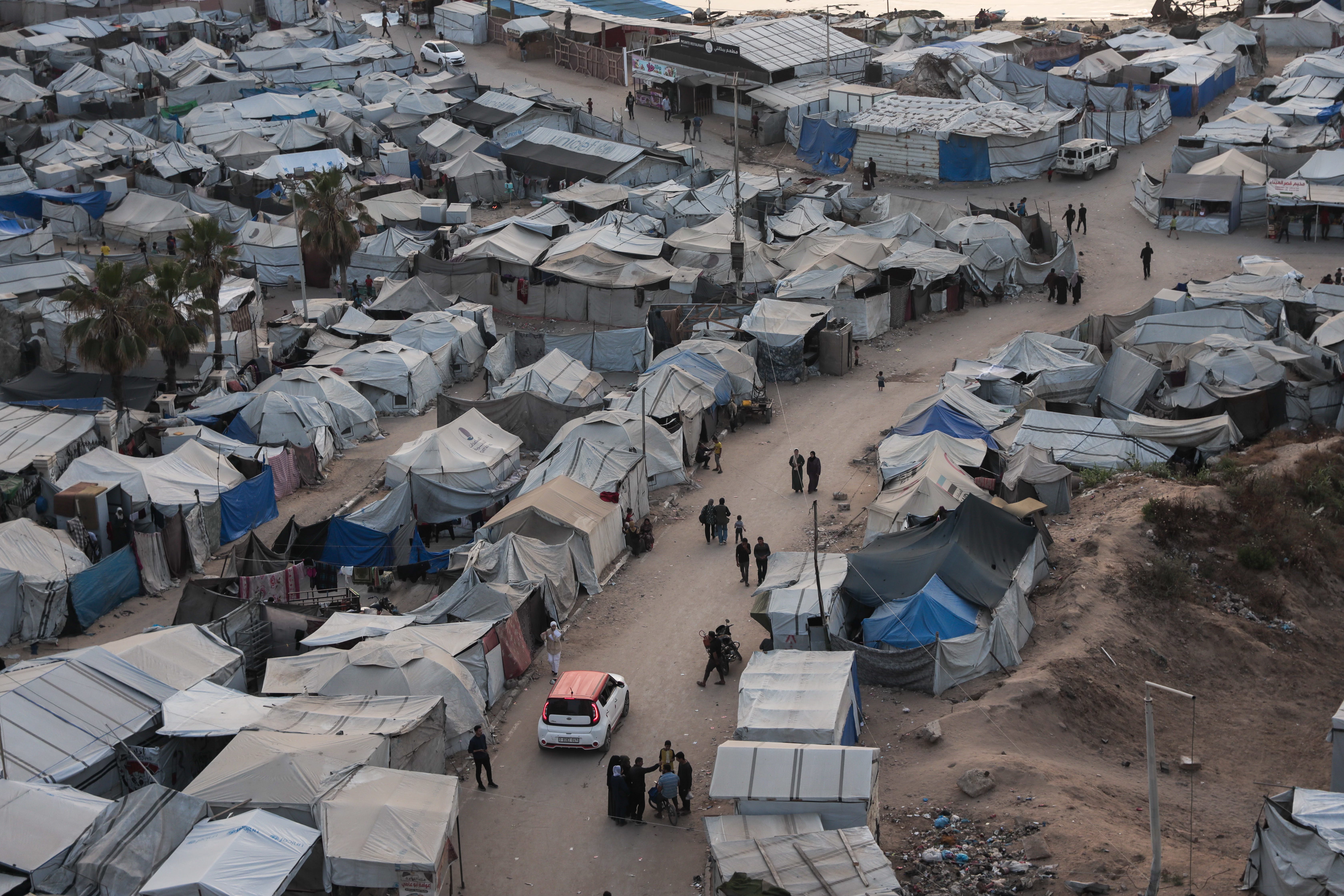
While the Board of Peace’s May 15 report to the UN Security Council acknowledged ongoing daily violations, “impediments to humanitarian access,” and uncleared rubble resulting from the destruction of “85 per cent of buildings and infrastructure,” it does not identify the responsible party, Israel.
Israel has also prevented the commencement of real recovery efforts. Alongside the October deal, Hamas agreed to formally recognize a newly established local police force as the law of the streets and to hand over all governance responsibilities to a council of 15 independent Palestinian technocrats. Known as the National Committee for Administration of Gaza (NCAG), it is the only Palestinian representation within Trump’s Board. Israel has refused to allow the NCAG members, currently based in Cairo, to even enter the Strip, however.
Hamdan told Drop Site that the Board of Peace has also prevented Hamas from holding any meetings with the Committee, further complicating efforts for a transition of power. “We want to see this administrative committee present in Gaza and carrying out its work there. Everything that needed to be prepared for this committee to function has already been done,” said Hamdan. Hamas, he said, has created a mechanism for handing over power, guaranteeing the security of the Committee members, and facilitating them assuming control of the police. “Despite it being formed and approved, Israel still refuses to allow it to enter, and Mladenov has failed to convince the Israelis or compel them.”
In the meantime, Hamas remains the only governing and security body in Gaza, responsible for overseeing everything from medical services to garbage collection to law enforcement. Both Israel and officials from the Board of Peace have, however, characterized Hamas as refusing to relinquish power, thereby preventing the entry of the NCAG, and have blamed it for delays in reconstruction. “At this stage, the principal obstacle to full implementation remains Hamas’ refusal to accept verified decommissioning, relinquish coercive control, and permit a genuine civilian transition in Gaza,” the Board of Peace claimed in its report. Mladenov recently accused Hamas of “consolidating its grip” on power in western Gaza.
Al-Hindi confirmed that all resistance forces in Gaza have pledged to support the administrative committee. “Committees were formed inside Gaza—including committees from Hamas, Islamic Jihad, the Popular Front, and Fatah—to facilitate the transition process and the transfer of full powers, including security and police authority, to the technocratic committee,” Al-Hindi told Drop Site. “Despite all this, Israel is preventing it. It appears that Israel does not want any Palestinian body to govern the Strip, including the technocratic committee, nor does it want the resistance to retain weapons,” he added. “At the same time, it is arming militias loyal to Israel—providing them with weapons, salaries, food, money, vehicles, and everything else—and wants them to administer Gaza instead.”
Hamdan said that Hamas has told mediators that the failure to implement the terms of the agreement sends a message to Palestinians that negotiations are meaningless. “It reinforces the belief that the United States does not want to implement what was agreed upon, and that Mladenov is merely an employee rather than a political figure capable of accomplishing the mission,” he said. “If that is the situation, then why should we even discuss other issues?”
Mladenov, Bulgaria’s former Defense and Foreign Minister, is well known to Palestinian leaders. From 2015 to 2020, he served as UN Special Coordinator for the Middle East Peace Process and frequently visited Gaza, where he met some of the very officials to whom he is now issuing edicts, including Al-Hayya. Mladenov serves as director general of a research academy that trains diplomats from the United Arab Emirates, Israel’s closest Arab ally. Jared Kushner, Trump’s son-in-law and the architect of the Abraham Accords—a series of Arab-Israeli normalization agreements that bypassed the Palestinians—praised Mladenov for assisting in the effort, saying, “We confided in him.” Until his appointment to Trump’s board, Mladenov was also a visiting fellow at the Washington Institute for Near East Policy, a pro-Israel think tank established by veterans of AIPAC.
“The intention of this plan is to go to the next level of permanent Israeli control of redefining—in an even more egregious way—the nature of the Bantustan on offer, while keeping the further expulsion and displacement of Palestinians in the mix,” said Daniel Levy, a former Israeli negotiator during the Oslo B talks in 1995 and, under Prime Minister Ehud Barak, at the Taba negotiations with the Palestine Liberation Organization in 2001. Levy told Drop Site, “Mladenov’s the guy for that. And the Board of Peace is the vehicle for that. And the way Mladenov conducts himself is absolutely aligned with that Israeli project.”
In a recent speech after meeting with Netanyahu in Jerusalem, Mladenov suggested that Hamas should not be allowed to participate in any future elections unless it accepts the disarmament demands. “A political party that disavows armed activity can compete in national Palestinian elections,” he said on May 13. Hamdan, the senior Hamas official, told Drop Site, “International parties informed us that if elections were held and Hamas participated, they would not recognize the results,” saying, “the mindset dealing with the Palestinians seeks to reshape them according to Israeli preferences. This cannot and will not succeed.”
“Mladenov wears multiple hats. At the UN he was, despite many flaws, still a UN official. So he was giving the pretense of being inclusive or objective or neutral to maintain access,” said Shehada. “But now that he’s a high representative of the Board of Peace—a title that sounds to be pulled out of colonial Congo—there is a total alignment between Mladenov and Netanyahu. This time around he’s more or less just delivering to [the Palestinian negotiators] the Israeli government position as his own initiative and asking them to take it or leave it.”
A spokesperson for Mladenov and the Board of Peace declined to respond to detailed questions from Drop Site, instead pointing to Mladenov’s recent speech in Jerusalem.
In those remarks, Mladenov rejected the notion he was doing Netanyahu’s bidding or issuing ultimatums to Hamas. “This was never a take it or leave it text. It was and it remains a very serious document,” he said, referring to the new roadmap. “It is based on a very, very important principle and that is reciprocity. Each step that we suggest to be taken by one side triggers a step to be taken by the other and each step is confirmed, or should be confirmed, by an independent monitoring mechanism before the next step is taken. That mechanism is being built around a very, very hard fact that we all know: Trust between Israelis and Palestinians is well below zero.”
Despite his public pledges, Mladenov’s actions behind closed doors have sent a different message. In the recent negotiations with Hamas, Mladenov has been joined by a senior Trump advisor, Rabbi Aryeh Lightstone, a hardline supporter of Israel who played a key role in the 2020 Abraham Accords. In a letter to the Palestinian administrative committee, obtained by Israeli media, Mladenov and Lightstone threatened that if Hamas refuses to capitulate to the disarmament edict, the ceasefire terms would be canceled, paving the way for Israel to resume its large-scale military operations and halting aid deliveries to Gaza. “Failure by Hamas to accept the framework within a reasonable timeframe, as determined by the Board of Peace and after consultation with the parties, shall render such commitments null and void,” the letter said.
Naim recently wrote on X that Mladenov was “not fit to oversee even a single day of a transitional administration” in Gaza and accused him of “threatening Palestinians with a return to war on behalf of Netanyahu and his fascist government, instead of acting as a true envoy of a body that calls itself the ‘Peace Board.’”
On May 21, Mladenov briefed the UN Security Council and then posted a lengthy thread on X in both English and Arabic in which he sought to cast his 15-point roadmap as a phased, neutral approach focused on trust building and independent verification. “The objective is not simply to preserve a ceasefire,” Mladenov wrote. “It is to move Gaza out of a permanent cycle of war and humanitarian collapse toward recovery, reconstruction, and Palestinian self-governance.”
Shehada described Mladenov’s posts as “flowery word salad” aimed at distracting from the core reality of his roadmap: It contains no enforceable terms for Israeli withdrawal, while demanding the total disarmament of the Palestinian resistance as a precondition for fully implementing the humanitarian and reconstruction protocols of the agreement.
Naim charged that Mladenov was trying to build public pressure on Hamas to capitulate, by falsely characterizing his roadmap as a great deal for Gaza that Hamas is blocking. “He wants to take the negotiation from a closed room, where he failed to make any serious penetration, to talking about this publicly,” Naim asserted. “He is trying to create a narrative to say for the Palestinians that the only thing which is blocking this track is the refusal of Hamas to be disarmed.”
Mladenov and other officials, Naim said, have privately acknowledged the Board cannot guarantee Israel will abide by the terms of any agreement and would continue to assert the right to strike in the name of “self defense” as it has done repeatedly in both Gaza and Lebanon, despite U.S.-sponsored ceasefire agreements. “It’s not only one party has to be disarmed and the other party can continue to attack,” Naim said. “Any security measures have to be mutual. Palestinians, as an occupied people, always have the right to resist. If they want to get rid of the resistance or the arms, we have to get rid of the occupation.”
The Disarmament “Non-Starter”
Hamas paid an enormous strategic price in negotiating the October ceasefire deal when it agreed to hand over all of the Israeli captives held in Gaza, using up its strongest leverage over Israel. Throughout the war, senior officials from Hamas and Palestinian Islamic Jihad maintained that they would only engage in phased exchanges of captives as a way of ensuring that Israel abided by each step of any agreement. In the end, after months of intense internal debate and consultations with political, community and religious leaders inside of Gaza, the Palestinian negotiators—facing unprecedented pressure from Arab countries and a horrifying ground reality inside Gaza—moved forward with releasing all remaining captives. In exchange they received direct assurances from Trump and top officials from mediator nations of Qatar, Egypt, and Turkey that they would hold Israel accountable for its end of the deal.
“This is a risk, but we trusted President Trump to be the guarantor of all the commitments made,” senior Hamas leader Mousa Abu Marzouk told Drop Site at the time.
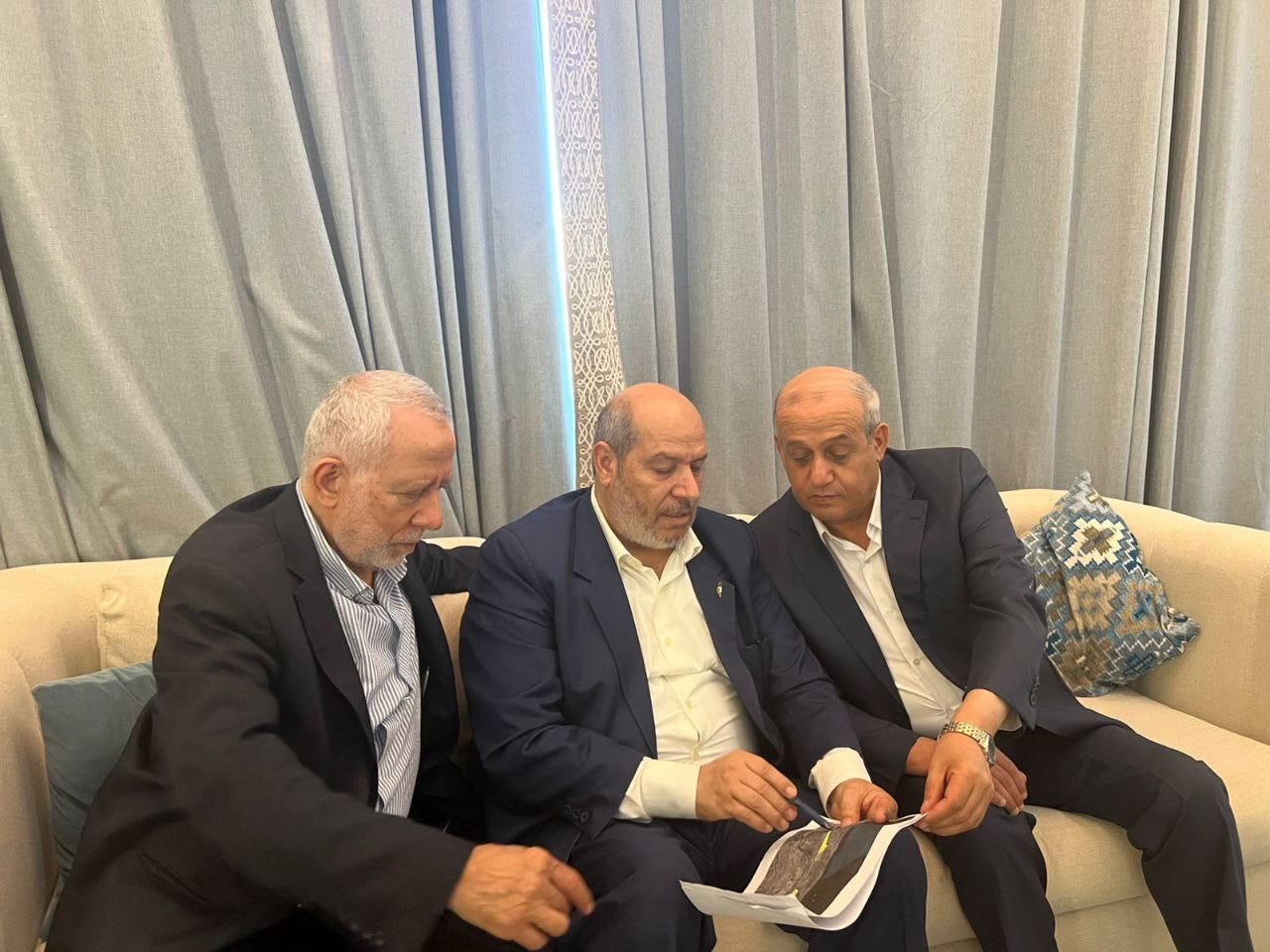
Leading the U.S. delegation at the talks leading up to the October agreement were Trump’s Special Envoy Steve Witkoff and his son-in-law Jared Kushner. Hamas understood that Trump was the only person capable of compelling Israel to abide by an agreement. It had no illusions regarding Trump’s loyalty to Israel, but assessed that it was the only viable diplomatic path. “The United States mediated, and Mr. Witkoff himself told the movement’s delegation directly—not through intermediaries—that President Trump thanks you and personally commits that this agreement will be implemented,” said Hamdan. “If he is unable to implement what he and his president have committed to, then there is no reason to believe any further commitments.”
Netanyahu, meanwhile, has publicly boasted of how Israel exploited the original deal and suggested Israel will move forward with occupying more of Gaza. “We did not give back territories. Did you hear [me]? We returned all our hostages,” Netanyahu said in a speech on May 14. “There were those who said ‘Withdraw! Get out of there!’ We didn’t get out of there. Today we control, how much? 60 [percent of the Strip], 60%, that’s today. Tomorrow we shall see. Tomorrow we shall see.”
Hamas’s decision to release all Israeli captives at the front of the deal was controversial, both within the movement and among Palestinians in Gaza. In the face of constant Israeli violations of the ceasefire and threats to resume the genocide, it remains a source of intense debate. “At that moment, it was seen as the appropriate decision to be taken by the leadership of the movement,” said Hamdan. “It is difficult now to assess this matter because we are still in this political back-and-forth. Perhaps many people hold the view that prisoner exchanges should have been the final stage. However, we were at least speaking about a complete package. The Israelis’ failure to implement what follows this stage pushes the Palestinians—and us as well—to say that without the implementation of this stage, there will be no trust in subsequent stages.”
While Israel’s intense genocidal operations receded in the aftermath of the agreement, almost none of the terms of the deal have been implemented as agreed. It has continued to kill Palestinians with impunity.
“In Sharm El-Sheikh there was a plan that was agreed upon. The first phase of the plan included commitments from both the Palestinian resistance and Israel. The resistance fulfilled its commitments and implemented them, including the prisoner exchange that took place. Israel, however, did not abide by any of its obligations,” said Al-Hindi, the Islamic Jihad official. Despite the guarantees, however, the U.S. did nothing. “The American guarantor—Trump came to Sharm El-Sheikh and brought along all these figures with him—focuses only on the issue of weapons and does not want to discuss anything else, just like Israel. The [regional] mediators and guarantors, despite understanding the situation, do not have the ability to compel Israel to abide by anything.”
On November 17, 2025, the UN Security Council voted to endorse Trump’s Board of Peace, giving it sweeping authority over Gaza. The U.S. envoy to the UN, Mike Waltz, told the member states that the genocide would resume if the council did not bend to Trump’s demands, saying that, “A vote against this resolution was a vote to return to war.”
In an unprecedented move, the council endorsed the deployment of an international force that would not operate under the banner of the UN, but would instead be commanded and controlled by Trump and his board. “The most disturbing part of this is they now have the cover of a UN Security Council resolution,” said Levy. “They now can do this with the imprimatur of the United Nations.”
In February, Hamas officials told Drop Site they had no contact with the Board of Peace since its establishment and were not engaged in negotiations. They saw reports in the Israeli media that Trump was considering giving Hamas a two-month deadline to disarm or face a resumption of the war, but nothing had been communicated to the Palestinian leaders. “Very importantly, Hamas must uphold its commitment to Full and Immediate Demilitarization,” Trump wrote in a post on Truth Social on February 15 ahead of the first meeting of his board, which Trump claimed, “will prove to be the most consequential International Body in History.”
A month later, Hamas officials were invited to meet with Mladenov and presented—for the first time—with the formal, unilateral disarmament edict. Negotiators from Hamas and Palestinian Islamic Jihad have continued to engage with Mladenov and regional mediators and they shuttle between Cairo, Doha, and Istanbul for talks. Hamas officials say they consistently present reports on Israeli violations of the ceasefire, including daily lethal strikes in Gaza and the continued blocking of aid, to no avail. Proposals are exchanged dealing with disarmament, but they keep ending in the same deadlock.
The Board of Peace has effectively codified as policy Israel’s demand for disarmament, resistance leaders said, as a proxy for a surrender of the Palestinian cause. “This does not concern the Palestinian resistance factions alone, but the entire Palestinian people. We have reaffirmed this, and it is also included in our responses to Mladenov,” said Al-Hindi.
Hamas maintains that disarmament can only be negotiated in the context of the establishment of a Palestinian state with a security force capable of defending its people. Armed resistance movements, Palestinian leaders assert, should eventually be transitioned into national forces. “If we are going to talk about weapons, then we must talk about Palestinian rights to independence, sovereignty, and the establishment of a Palestinian state. This must be a matter of Palestinian national consensus,” Hamdan said.
“When we have the state, or at least an elected government, we can talk about giving up or handing over the arms to this elected government or state, and the fighters can be part of a national guard,” said Naim.
Hamas, Hamdan added, told Mladenov that it was open to negotiating the terms of the second phase of the deal, which includes the issue of weapons, as long as the implementation of the first phase was progressing and Israel held to its commitments. But, Hamdan cautioned, it must be “without any demands for us to carry out what is agreed upon [in a second phase] until the first phase has been fully implemented.”
As Drop Site has previously reported, Hamas repeatedly suggested to regional mediators a solution to the weapons issue wherein the Palestinian resistance would agree to store or “freeze” its weapons and not deploy them in any attacks against Israel as part of a long-term truce. The weapons, however, would potentially be accessible in the event that Israel violates the terms of the deal and resumes war against Gaza. This approach would come with the endorsement of the Palestinian resistance groups themselves. But it all is predicated on a political process.
“You cannot simply take one point, which is disarmament, as the cornerstone of the whole plan, and if this does not succeed, we cannot move forward with either reconstruction or the national technocratic committee or the political track,” said Naim. “Before talking about decommissioning or disarmament, there are a lot of things that have to be implemented.”
Levy, the former Israeli negotiator who is now president of the U.S./Middle East Project, said that if the issue of the weapons of the resistance was actually an Israeli security concern, Hamas’s proposals would be seen as a reasonable basis to negotiate a resolution. Israel has publicly acknowledged that Hamas’s rocket capacity has been overwhelmingly depleted and destroyed and that most of what remains are automatic rifles, improvised explosive devices and small arms. “The kinds of things that Hamas have put on the table and divesting themselves of governance in Gaza are far reaching positions,” he said. “Israel isn’t interested in any of those. It’s just interested in using this as the excuse to lumber forward with its plan.”
Shehada, the analyst from Gaza, said that Israel and Mladenov have presented Hamas with a “non-starter,” by demanding unconditional disarmament that would amount to a public surrender ritual. “It is something that they already know Hamas would never agree to—not a single Palestinian armed faction would agree to—or even if all of those factions would agree to it, most members on the ground would refuse to agree to it,” Shehada said. “Once you get them to say, ‘No,’ you put the ball in their court, you put the blame on them, and you absolve the other party of any obligations whatsoever.”
Potemkin Village
In the absence of a comprehensive deal with Hamas, the short-term options for Trump’s Board ultimately come down to: authorizing Israel to resume a large scale military assault in western Gaza in the name of “disarming Hamas”; supporting Israel in formally seizing control of the territory in Gaza it currently occupies while continuing the low intensity siege on the rest of the Strip where Hamas remains in control; and, according to reports in the Hebrew media, splitting Gaza into two cantons, one controlled by Israel and the other under Hamas control, but denied basic goods. Israeli officials, meanwhile, continue to speak of returning to Gaza and re-establishing illegal settlements and continuing efforts to expel Palestinians.
“Israel’s project is not the same as the American project in Gaza,” said Al-Hindi. “The American project in Gaza is tied to their regional and international vision. Israel’s project is based on expelling the population and preventing any Palestinian administration from existing except one operating in the name of the occupation.”
Israel has calculated that it can sabotage any deal by miring it in endless technical negotiations, which Levy referred to as “relentlessly moving the goalposts,” until the agreements fall apart or inertia makes the easiest path for mediators to accede to Israeli demands.
“At times, it becomes clear that the goal is simply to maintain this tension,” said Hamdan. “[Israel] does not allow Palestinians stability and to rebuild their civilian lives, nor does it allow mediators to succeed in their mission, nor does it give Mladenov any room to claim progress.”
On May 20, the Israeli Knesset voted to dissolve itself, potentially paving the way for early elections. Most political analysts agree that Netanyahu believes it is strategically advantageous to campaign for re-election in a state of war while maintaining his hardline position on the Gaza negotiations. “Depending on where the Iran war goes, depending on whether he’s constrained in Lebanon or not, Netanyahu wants to keep open the option of intensified military actions in Gaza,” said Levy.
“You have a vested Israeli interest in keeping Gaza at a standstill. Zero progress whatsoever,” said Shehada. “Netanyahu understands the spectacle of reconstruction in Gaza would be very damaging to his election campaign. Gaza needs to be in ruins for the foreseeable future. So the chances of Netanyahu agreeing to reconstruction, even if Hamas accepts the entire Mladenov plan, it’s zero. The Israeli political mainstream is still very much absorbed with the idea of ethnically cleansing Gaza.”
The United Arab Emirates and other Israeli or Trump allies also appear committed to profiting off of a fraudulent Gaza reconstruction project, beginning with the creation of a “Potemkin village” in the eastern areas of Gaza under Israeli control. “You have people in the White House that are invested in it because in east Gaza, there are no external observers, accountability, due process, government, or even people. There is only the [Israeli-backed] gangs,” Shehada said. “So you’re building a pretend village for a pretend population, and a lot of people would get rich out of it.”
Read more: Leaked Documents: “Planned Community” in Rafah Would Force Palestinians Into Israeli Panopticon
In its report to the UN Security Council, the Board of Peace estimated that the costs of its promised Gaza reconstruction project would exceed $30 billion. It also “estimates total recovery and reconstruction needs in Gaza at $71.4 billion over the next decade.” While the Board claimed to have received $17 billion in pledges, much of that money clearly has not hit the bank and may never materialize. The Times of Israel reported that roughly 1% of the commitments have been fulfilled. The Board warned “that the gap between commitment and disbursement must be closed with urgency.”
“Who is going to pay today for Kushner’s [plan]? This is a deal from which Kushner and his associates want to benefit. After what happened in Iran and the war, no one really has money to pay—maybe the UAE has some,” said Al-Hindi. “They say they want to rebuild Gaza according to Kushner’s plan, with the skyscrapers and designs we saw? If they truly intended to rebuild, then in their minds it was a deal serving their own interests: taking billions of dollars for their companies to construct projects either for themselves or for Israeli settlers. But the plan ran into obstacles. And it is clear that in order to move forward with this step, they need there to be no resistance or weapons in Gaza.”
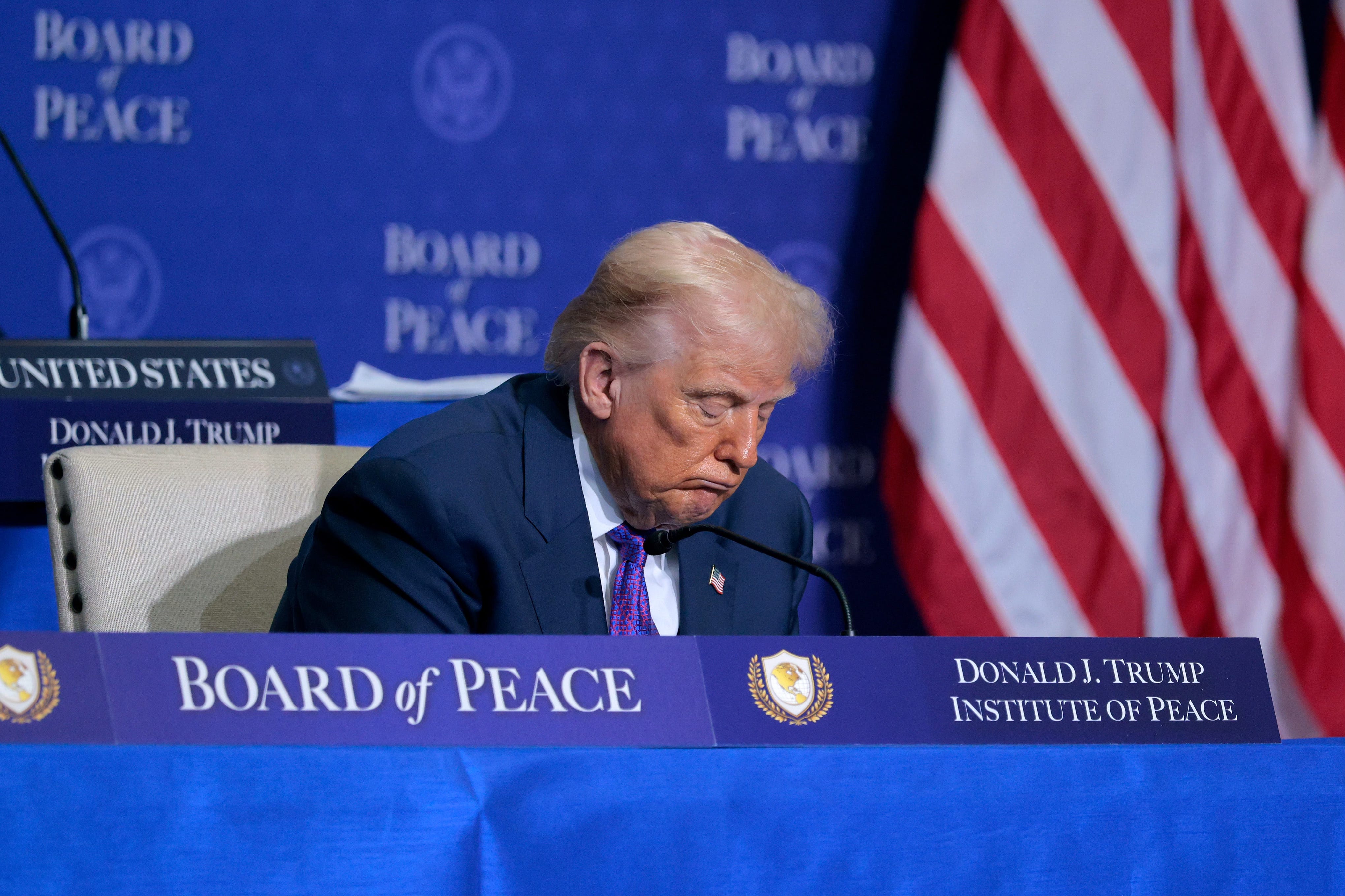
Mladenov and Netanyahu, according to reports in Hebrew media, are discussing moving forward with a plan to increase aid to areas of Gaza under Israeli control if Hamas refuses to disarm, effectively splitting Gaza in two. The plan would reportedly divide the Strip into, “red Gaza,” which is nominally controlled by Hamas and is denied sufficient supplies of basic goods and services or reconstruction, and “green Gaza,” which would consist of some camps for Palestinians but administered by the Administrative Committee under the supervision of the Board and with the presence of Israeli occupation forces.
NCAG would be allowed to enter Israeli-occupied eastern Gaza and would be expected to “encourage Palestinians to move there from the Hamas-controlled areas,” according to Axios, citing Board of Peace officials. “If you bring the Committee into the eastern part, what are they going to govern? There are no Palestinians there, only the gangs,” said Naim. “Palestinians, even today during this continuous aggression, are not just looking for food and medicine. They are looking to resume their life—food and medicine and education and free movement. It is not only about having a tent and some food and medicine.”
Naim said the “Kushner reconstruction plan is aiming to achieve the same goals of Netanyahu,” which Naim described as a “total isolating or total cutting of Gaza from the rest of the Palestinian territories. No Palestinian will accept such a plan.”
In an interview with Fox News on May 10, Michael Eisenberg, a senior advisor to Netanyahu and a member of the Board of Peace, falsely claimed that in the event Hamas refuses to disarm, the Board has the authority to “go in, and move in, and start taking sections of Gaza and forcibly disarm Hamas if need be. And so, this was just incredible foresight. This is just incredibly well thought out.” Eisenberg, who was appointed to Trump’s Board by Netanyahu where he helps coordinate IDF operations, claimed this authority was contained in Trump’s 20-point plan. No such term exists in that document. Instead, the document says that if Hamas does not agree to the proposal, then the rest of Trump’s plan, including a “scaled-up aid operation,” will be implemented in “terror-free areas.”
U.S. Ambassador to Israel Mike Huckabee said recently that an international force would not be capable or willing to engage in disarmament operations and suggested Israeli forces would ultimately launch military operations in areas of Gaza controlled by Hamas under that banner. “Who is actually going to do the disarming? I don’t know. It could end up that the only entity willing to do it is the IDF,” Huckabee said at a conference in Tel Aviv on May 12.
The issue of Hamas’s weapons, Levy said, also serves as a constant tool of justification for Israel’s own refusal to implement its side of the agreement. “Israel is testing the waters, making sure that they’re not caught short on anything, that there’s no actual Palestinian governance there, that there’s no actual Israeli withdrawal, that they aren’t put in a position where they have to stop killing, that there’s no actual international force because that sets a dangerous precedent,” Levy said.
“If they decide to go ahead with the war again, I believe it will not be based on the negotiations and what is the outcome of these negotiations. It is based on the American decision [on whether] to give Netanyahu the green light, and on the internal calculations of Netanyahu,” said Naim, the Hamas negotiator. “If they want to do it, they will not wait for the results of the negotiations.”
While Israel may ultimately decide to escalate military operations in western Gaza in an attempt to forcibly seize it, officials from both Hamas and Islamic Jihad said it would ultimately fail to conquer the Strip or to eliminate the armed resistance that has existed for more than 77 years. “This option is costly for Israel, but at the same time it wants to take everything without paying any price. That is clear to us. It wants to occupy Gaza? Let it occupy Gaza. Gaza was occupied before and had no weapons at the time, and the Palestinian people developed weapons and expelled the occupation,” said Al-Hindi. “Gaza, in the end, has no solution except the recognition of the rights of the Palestinian people. Israel’s options in dealing with this are difficult. Israel wants to displace the Palestinian people, and this will not happen. The Palestinian people are holding onto their land, and the resistance continues.”
“The Arrogance of Power”
Among the hallmarks of Trumpism are pomp and ceremony. At Sharm El-Sheikh in October, the U.S. president basked in his own glory, assembling Arab and Islamic leaders at a table to praise his “peacemaking” and sign a meaningless document titled, “The Trump Declaration for Enduring Peace and Prosperity.” Kushner presented slideshows depicting a future for Gaza featuring high end resorts and tech centers. Palestinian children would be reeducated and taught to love and respect Israel and Zionism.
Another hallmark of Trumpism is that fantasy ultimately fails to be borne out in reality. The touted projects sit in a state of decay. Trump, consumed with his quagmire in Iran, rarely speaks of Gaza except to boast—falsely—of how he ended a millenia-long conflict. “The more Iran is weakened, the more Hamas is weakened,” he recently told Axios.
“Even before the war with Iran, it was evident that the American administration’s priority was to create an image rather than achieve real progress,” Hamdan said. “The reason for this may lie partly in President Trump’s approach, but also in the fact that he fully understands that Israel will not accept a solution, and he does not want to enter into a confrontation with Israel. I think this is the recurring problem: what Israel wants is taken into account and respected, while the fundamental Palestinian rights are not treated as a priority.”
Netanyahu is at the apex of his long career and Israel may never find itself in a more ideal position to enlist the full force of the U.S. government in the pursuit of its broader agenda. A recent analysis by the Financial Times found that Israel has occupied more than 380 square miles of territory in Gaza, Lebanon, and Syria since October 2023. This includes large areas of southern Lebanon, almost two-thirds of Gaza as it pushes past the agreed-upon “Yellow Line,” and positions inside Syria following the collapse of the Assad government.
But Levy, whose experience as an Israeli negotiator and as a witness to the wars on Gaza and expansion of illegal settlements in the occupied West Bank led him to become a critic of Israel, said that the ultimate outcome may not be as Netanyahu currently envisions. “I think going into this war against Iran, Israel wanted to drive home the message that all resistance is futile—resistance in the broadest sense of the term, not just armed resistance as part of a strategy deployed to counter Israel,” Levy said. “And there’s been severe blowback because I think the outcome now is Hamas is still on the ground in Gaza. Hezbollah is still offering resistance in Lebanon. Iran is anything but defeated. And I think that the lesson that many people in the region are taking forward is the opposite to that which Israel was trying to impose, which was one of surrender.”
Hamdan linked the current demands that the Palestinian resistance unilaterally disarm to the broader U.S.-Israeli agenda and the wars of the past three years. “The idea of disarmament is not truly about peace; it is about making Israel dominant in the region through force, and the United States in control of the region through military power,” he said. “No rational person would accept moving from a condition of freedom—even if it involves suffering and death—into a condition of slavery and humiliation. Therefore, we say the best protection for the Palestinian cause is the continuation of resistance.”
Al-Hindi, who has been a leader of the Palestinian struggle since the 1980s, said that while it may appear that Israel has succeeded in pacifying the armed resistance in Gaza, Israel has significantly undermined its international support and degraded its own defenses—factors likely to have far reaching consequences.
“To win a battle or to win a war are two different things. Israel has won battles—it has bombed, destroyed, and operated in Gaza—but it has not won the war. It has also not decisively resolved any front, despite all the boasting,” he said. “This arrogance—the arrogance of power—is destructive. When a side does not see others and believes it is superior, more intelligent, and more powerful than them, this arrogance eventually leads to destruction.”
The genocide in Gaza and the violent expansion of illegal settlements and mass forced displacement in the occupied West Bank, Hindi said, will eventually reach another boiling point. “The increase in pressure, repressive policies, collective punishment, the expulsion of people from their homes, and the killing of children—all of this leads in one direction: an explosion of an intifada, no doubt,” he said. “This is coming.”
When the administration gets to keep all the money in an offshore account and the son in law of the president literally develops settlements on stolen land, what could go wrong?
This is the history of every single ceasefire ever brokered with Israel, especially those mediated by the US. Just total perfidy and dishonesty all the way down by both Israel and US negotiators. Exactly the same script was played out during every Gaza incursion in the past. Read Jeremy Hammond's excellent book Obstacle to Peace.