

“Praise Allah, There Are Still People Like You”: Jeffrey Epstein Nurtured Israel-Emirates Ties Before Abraham Accords
Epstein leveraged his friendship with the chief of DP World to pitch Israeli logistics infrastructure and cybersecurity investments to the UAE.


The UAE has been making an ambitious play over the past decade for regional dominance stretching from their own shores to the Horn of Africa and beyond, paying particular attention to control of the Red Sea. In addition to its recent gambit with Israel to entrench a separatist state in Somaliland over the furious objections of both the Arab League and African Union, Abu Dhabi has begun challenging its own neighbors by bolstering an ill-fated secessionist uprising in southern Yemen. That movement was suppressed by a rapid Saudi-backed military offensive that has sharpened tensions with the Emiratis.
The UAE has learned to punch above its weight by mastering the art of buying influence with global elites—particularly in Washington, but also through a deepening strategic partnership with Israel that came into the open with the 2020 Abraham Accords. The story of how a diminutive Gulf state came to sit so close to the center of global power has never been fully told. And Jeffrey Epstein played a part in coaching Emirati elites and building the relationship between Israel and the UAE.
The story below, based on private correspondence from Epstein spanning more than a decade, tells the story of his intimate relationship with Sultan Sulayem, the powerful head of the Dubai Ports World financial empire and an individual closely connected to the Emirati ruling families. The story helps reveal the hidden backstory of the Abraham Accords, which were signed one year after Epstein’s death.
This is the latest in Drop Site’s series on Epstein’s intelligence ties, and there is more to come. More leaked communications to analyze. More security deals to track. But we can only continue if we have the resources and legal protection to defend this work.
We don’t answer to advertisers worried about powerful governments. We don’t have billionaire owners with business interests to protect. We answer only to you.
That’s why we can publish the Epstein intelligence investigations that mainstream outlets refuse to touch. And that’s why we need your support to defend them when those powerful interests come after us for publishing them.
If you value this reporting, can you make a tax-deductible donation today to help us keep going?
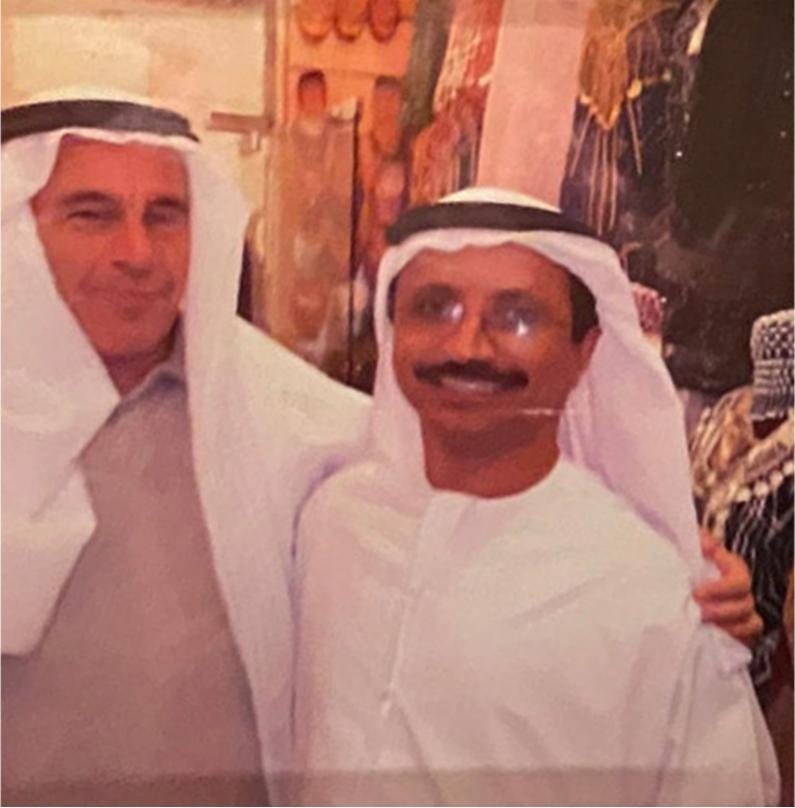
On December 26, 2025, Israel became the first country to recognize the Republic of Somaliland as an independent state, signing a mutual declaration “in the spirit of the Abraham Accords.” The surprise diplomatic announcement landed after months of public advocacy from one of Somaliland’s most important foreign investors: Dubai’s DP World, whose chief publicly argued for recognition at a conference in October—touting hundreds of millions of dollars invested in the company’s port at Berbera.
The Israeli move inflamed the government of Somalia, and drew denunciations from the African Union and Arab League. Formal recognition of Somaliland strengthens the UAE’s logistics hub in Berbera, where Israel is already building up a military base to protect their Red Sea shipping interests from drone and missile attacks by Yemen’s Houthi government. Israel’s efforts to shore up the government in Hargeisa come as the UAE continues its own brash series of interventions in the Horn of Africa, and support for the genocidal Rapid Support Forces in Sudan.
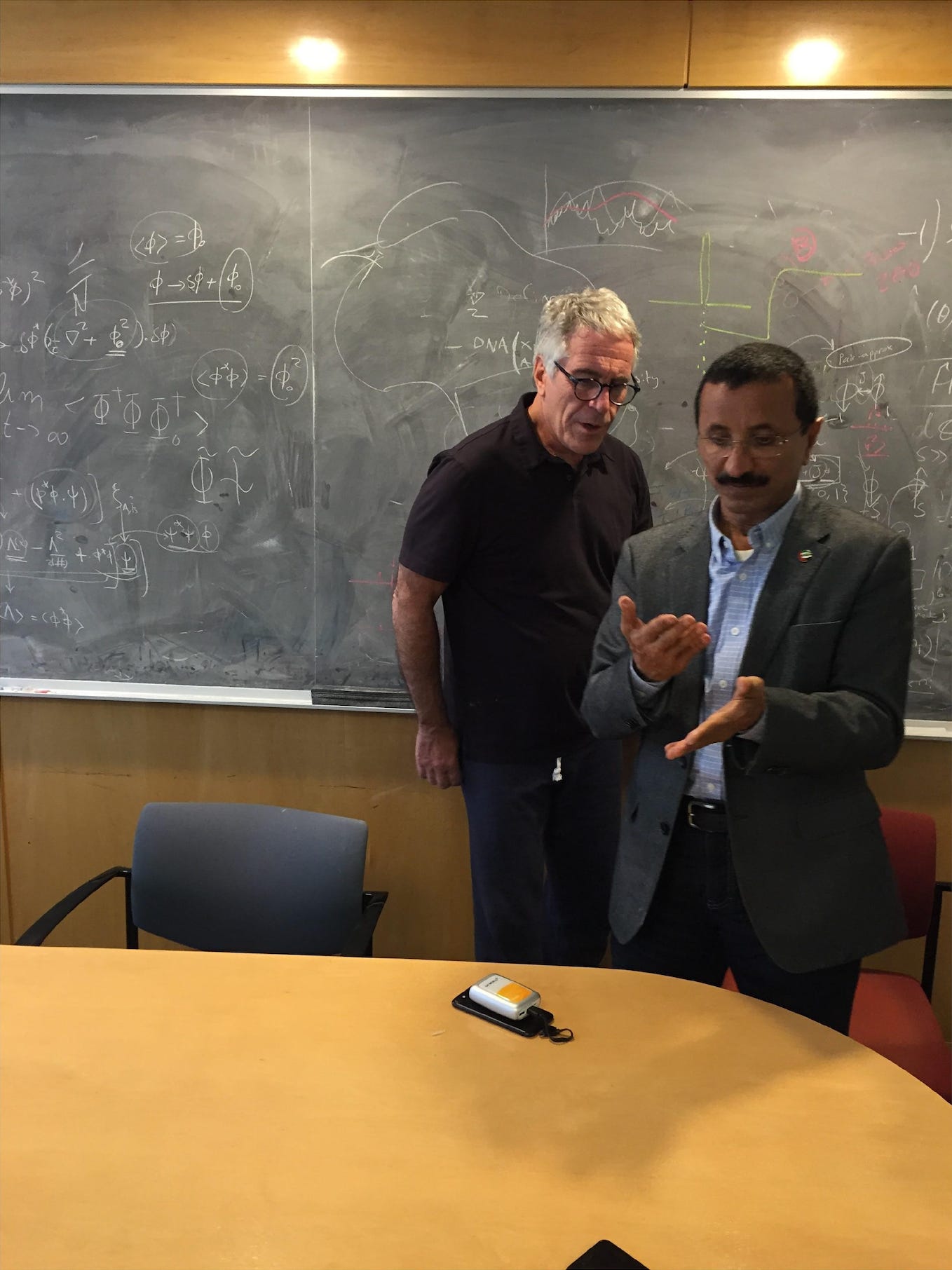
The strategic gambit in Somaliland marks another chapter in the deepening relationship between Tel Aviv and Abu Dhabi. In the last two decades of his life, American financier Jeffrey Epstein acted as an informal diplomatic bridge between Israel and the United Arab Emirates—through his intimate friend Sultan Ahmed bin Sulayem, the chairman of DP World and a close associate of the ruler of Dubai.
Epstein took a keen interest in DP World, one the world’s largest container terminal operators, which controls the Jebel Ali Free Zone (JAFZA) in Dubai, an essential logistics hub for trade transiting through the Persian Gulf. JAFZA is the U.S. Navy’s most frequently visited foreign port, and the U.S. has more ships in UAE ports than any other port outside the United States.
After bouncing back from his first prison stint for child prostitution in 2009, Epstein bragged about his relationship with “the owner of the deep-water port of Djibouti on the horn of Africa, a smuggler’s paradise.” The Port of Djibouti was DP World’s largest container terminal in Africa at the time. Epstein claimed that his relationship with Sulayem was so close, “he was basically in charge” of the port.
Epstein’s comments about the port sounded like grandiose exaggeration. But his claim of having an intimate friendship with Sulayem is now corroborated by a flood of his emails from the House Oversight Committee, a U.S. federal court case, and the hacked inbox of former Israeli Prime Minister Ehud Barak.
The conversations reveal Epstein’s extraordinarily close bond with Sulayem from at least 2006 through to his death in 2019—the date range of emails available from his leaked Yahoo! account. The email data was vetted and provided to Drop Site News by Distributed Denial of Secrets. Sulayem did not respond to requests for comment about his relationship with Epstein.
Epstein was a trusted friend and advisor to Sulayem, but his network appeared to extend across the stratum of Emirati elites. A journalist who visited Epstein in 2013 noted a photograph displayed in the anteroom of his New York mansion, showing Epstein with Mohammed bin Zayed, the Crown Prince of Abu Dhabi, wearing beachwear and snorkel gear.
In the decades before the Abraham Accords “normalization” in 2020, Israel and the UAE quietly built extensive intelligence and commercial ties. After the Accords, this relationship came fully out of the shadows: direct flights began within months, bilateral trade exceeded $1 billion within one year, and a free-trade agreement took effect the year after that, eliminating most tariffs. Meanwhile, UAE investment funds have invested heavily in Israeli artificial intelligence, biotechnology, and defense firms.
Epstein died one year before the signing of the Accords, and did not live to see the relationship between Abu Dhabi and Tel Aviv come into the open. But his behind-the-scenes efforts to foster ties between Israeli and Emirati elites helped lay the groundwork for a strategic partnership that is now reshaping the region.
“The only person I have met who is as crazy as me”
In early 2006, the Emirati elite were humiliated when U.S. politicians blocked logistics conglomerate DP World from acquiring six major U.S. seaports, turning the bid into a major national security scandal. After the company was forced to retreat, Sheikh Mohammed bin Zayed Al-Nahyan, then-Crown Prince of Abu Dhabi, vowed that the nation would never be caught flatfooted in Washington again.
In the aftermath of the scandal, as DP World withdrew from U.S. operations, Sultan Ahmed bin Sulayem emailed Jeffrey Epstein to arrange a meeting in New York in November 2006. Epstein was eager to meet, pressing Sulayem to “come sooner.” The following year, Sulayem was appointed chairman of DP World, as the company pushed ahead with international expansion and worked to steady its relationship with Washington.
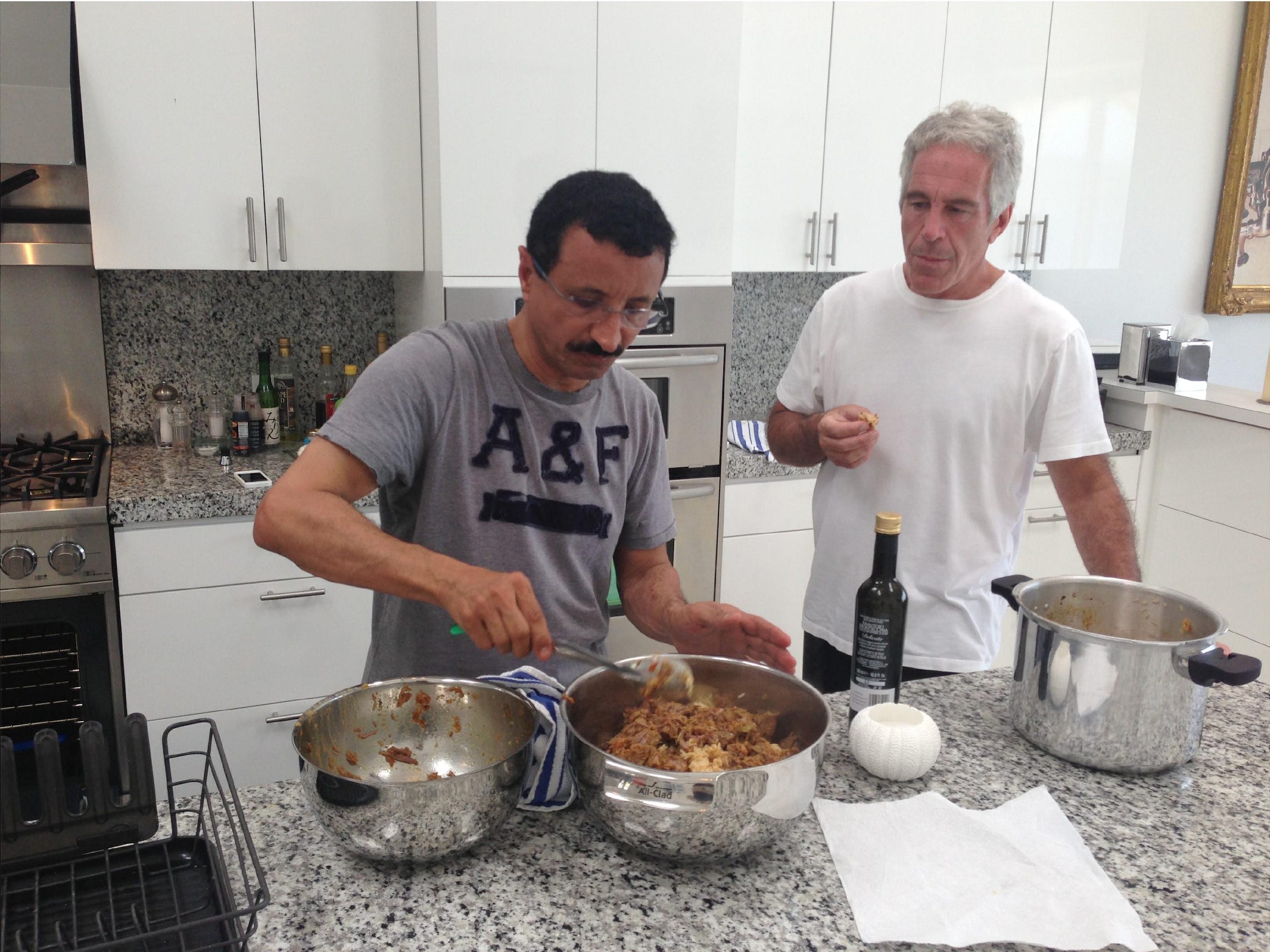
Epstein and Sulayem enjoyed a close personal relationship that transcended business. In November 2007, a few months after his indictment in Florida on sex abuse charges, Epstein mentioned to Sulayem hearing a “funny story” from a woman they both knew. Sulayem replied, “Yes after several attemps (sic) for several months we managed to meet in NY. There is a missunderstanding (sic) she she wanted some BUSINESS! while i only wanted some PUSSYNESS!” Epstein replied, “praise Allah , there are still people like you.”
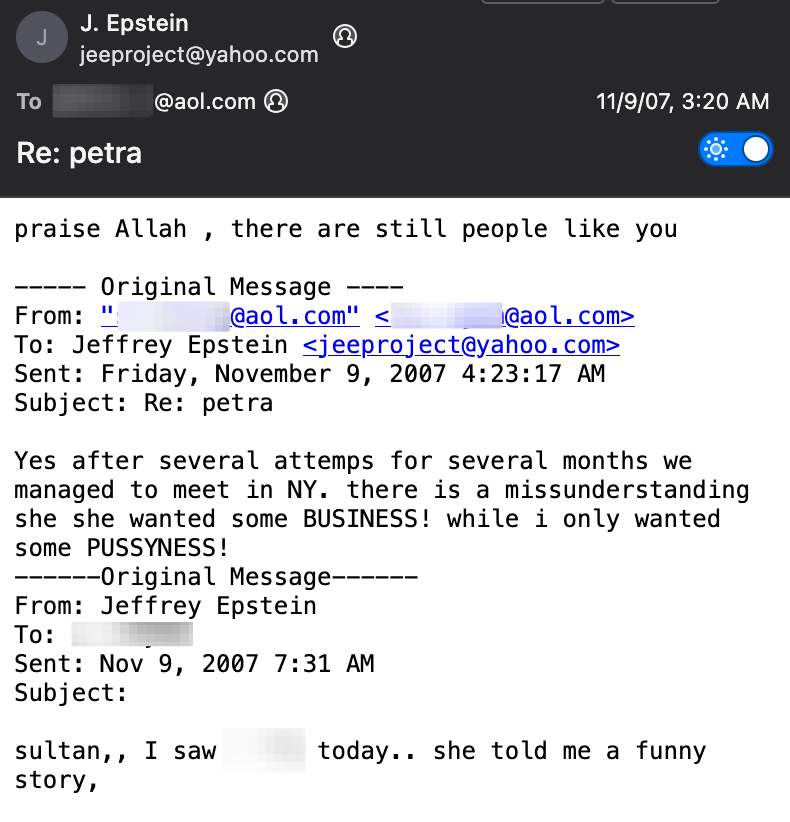
Earlier in 2007, while offering his advice on an expected IPO for DP World, Epstein reviewed early unpublished English translations forwarded to him by Sulayem of a book written by Mohammed bin Rashid al-Maktoum—the ruler of Dubai—and offered his feedback on the translation to improve the book’s reception abroad.
“His Highness should take great care to make certain his book ‘MY Vision’ , is translated with sensitivity and grace,” Epstein wrote. “The translations that I have read do not do his thoughts justice.” Epstein recommended a new title, “My Country’s POEM,” and offered his literary insight: “I’m sure it will be read by a wide audience of english speaking people, they will not comprehend his sophsitication (sic) if the words are crude, and the sentences awkward.” (Maktoum’s book was published in English several years later without Epstein’s recommended title.)
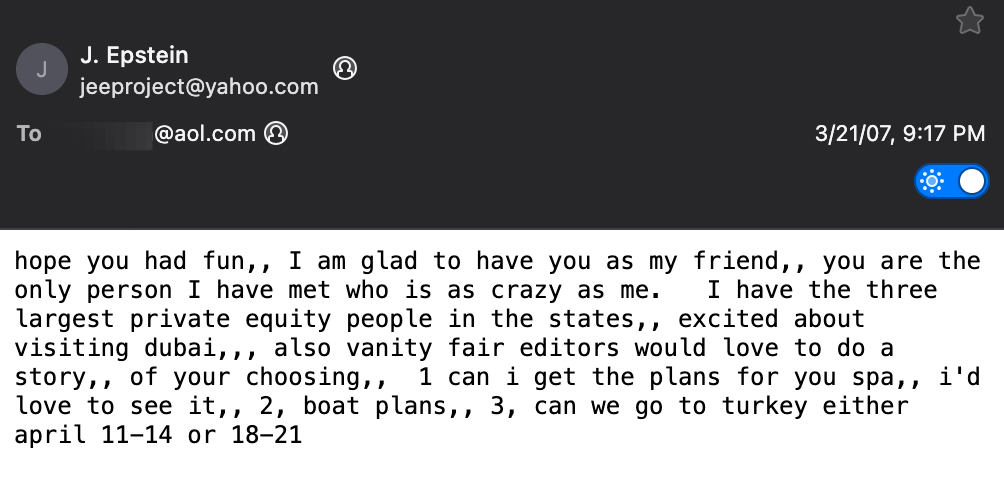
The two stayed in regular contact, discussing business strategy, coordinating meetings with senior business and political leaders, and arranging vacations at Epstein’s private island, Little St. James. Epstein wrote to Sulayem after one enjoyable excursion together in March 2007, “hope you had fun,, I am glad to have you as my friend,, you are the only person I have met who is as crazy as me.” After Epstein’s death, the Miami Herald discovered that Epstein’s neighboring island, Great St. James, had been purchased in Sulayem’s name in 2016. An aide for Sulayem told the Herald he had not given Epstein’s permission to use his name on the property title. (The island has since been sold to a private investment firm.)
Epstein’s legal troubles related to child sex abuse were compounding in the background of the two friends’ fun and debauchery. In June 2008, after taking a controversial plea deal that gave blanket immunity to Epstein’s “unnamed co-conspirators” and provided for a short, eighteen-month prison bid with work release outside the prison walls, Epstein informed Sulayem that they would have to take a hiatus from their adventures together. “Unfortunately ,, it looks like i am going on a forced vacation for a year,” he wrote dejectedly. “I look forward to getting this behind me, and then spending time with you.”
“I think you should meet”
The correspondence in Epstein’s Yahoo accounts contains several gaps where messages appear to have been deleted in bulk, including a significant missing window from 2008, during his first stint in a Palm Beach prison. But after Epstein’s return to public life in 2010, a second set of emails from the hacked inbox of Ehud Barak show Epstein and Sulayem’s relationship continuing to blossom, as Epstein began a concerted effort to strengthen ties between elites in Israel and the United Arab Emirates.
On several occasions in the mid-2010s, Epstein arranged meetings between Barak and Sulayem—pitching them as an opportunity for Barak to get closer to the ruler of Dubai, and promote Israeli diplomatic and security interests abroad. “I tnk [sic] you should meet,” Epstein wrote to Barak on June 18, 2013. “He is the right hand of maktoum.”
That day, Barak was visiting Russia for a private meeting with Vladimir Putin on the sidelines of the St. Petersburg International Economic Forum. (The meeting with Putin was part of a diplomatic backchannel coordinated with Epstein’s help, concerning a Russian-brokered regime change in Syria.) Epstein had a pattern of coordinating his own meetings with Barak’s; according to a travel itinerary emailed to Epstein by his assistant, the financier flew to Dubai and Africa for several days while his friends were together in Russia.
Upon Barak’s return to Israel from St. Petersburg, Epstein tried to facilitate a deal for Sulayem to invest in Israeli logistics infrastructure. He sent an email to Barak on July 4, 2013 with a link to a news article about foreign private investment in Israel’s ports, writing “is this something for sultan?” Barak viewed the proposal as premature: “I think it’s a little bit too early. Probably once (and IF) we’ll start getting deeper into a sincere peace process. Or alternatively after the next revolution on either side of the ME barricades.” But Barak encouraged Epstein to continue developing the relationship: “I think we have to think harder on how to leverage this acquaintance.”
Barak and Sulayem crossed paths again at the St. Petersburg summer conference in June 2015, with Epstein once again handling the meeting details. “I owe him. Last time he paid for my coffee and starters,” Barak wrote. Epstein quipped, “knowing how you eat, you owe him a lot.”
The relationship Epstein brokered continued to flourish. On August 5, 2018, Sulayem emailed Epstein about Carbyne, an Israeli cybersecurity company that Epstein had funded and Barak led as chairman, which enables emergency dispatchers and security services to retrieve precise location data and live video/audio feed from phones. In a message to both Epstein and Barak, Sulayem informed Epstein he was also intending to invest in the company, and he had discussed with Carbyne’s founder, Amir Elichai, about ways to use the technology for “Dubai 911” and personnel security at seaports operated by DP World.
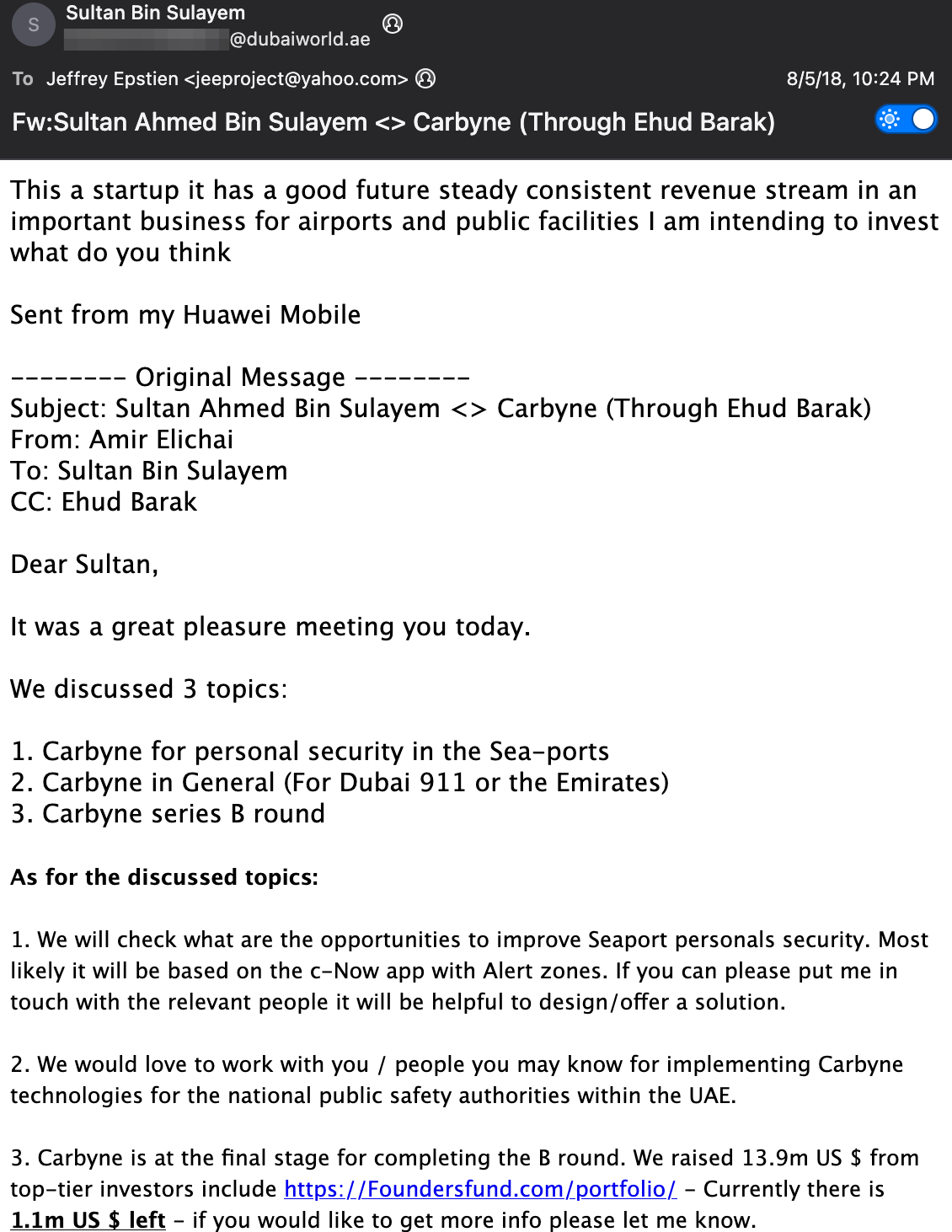
Sulayem forwarded an email from Elichai, a veteran of Israel’s Unit 8200 signals intelligence unit, proposing Sulayem’s participation in Carbyne’s Series B fundraising round that year. After meeting with Epstein and Barak, Peter Thiel had also invested in the round. Epstein introduced Barak and Elichai to one of Thiel’s venture funds while helping Barak develop relations with senior security officials in Mongolia. (Those talks had blossomed into a formal security agreement between Israel and Mongolia in 2017, which included plans for integrating Carbyne into the Mongolian emergency service.)
Drop Site could not confirm whether Carbyne was ultimately deployed in Dubai or DP World-linked port operations. However, later public reporting shows that UAE investors swiftly became involved in Carbyne after the Abraham Accords normalization in 2020. In September 2022, Carbyne announced a $56 million Series C round, and named Emirates-based fund TALC Investment among its participating investors. In 2024, Emirati businessman Mohammed al-Dhaheri also invested in Carbyne, as part of a portfolio tied to Abu Dhabi’s airport and security-infrastructure ecosystem.
Emirati money has continued to pile into Carbyne. This year, the company raised $100 million in July 2025 with participation from TALC Investment and KAAF Investments, the Dubai-based family office of Mishal Hamed Kanoo. Carbyne’s “Investors” page now includes Yousef Al Otaiba, UAE’s ambassador to the United States. Otaiba, who had been tapped by MBZ to rehab the UAE’s lobbying operation in the United States after the original DP World fiasco, had long cultivated ties with former CIA Director David Petraeus, who is also a backer of Carbyne.
“Arms, drugs, and diamonds”
Since the 1980s, the UAE has been a major transit hub for gems, minerals, metals, and contraband from around the world. During that decade, the once-sleepy emirate, known for its fishing and pearl diving industries, transformed into a center for transnational capital—including arms trafficking, diamond smuggling, and money laundering.
Central to this transformation was the Bank of Credit and Commerce International (BCCI), a bank created by seed capital from Abu Dhabi ruler Sheikh Zayed bin Sultan Al-Nahyan. BCCI earned a reputation as the preferred financial conduit for intelligence agencies and organized crime during the Iran-Contra scandal—a clandestine weapons and cocaine smuggling pipeline to which Epstein and several of his associates were connected.
During the Iran-Contra operation, the CIA’s covert arms deals were financed using accounts at BCCI and its vast network of shell entities, allowing illicit cross-border transactions, like multimillion-dollar weapons and drug shipments, to be shielded from regulators and the public. Planes from Southern Air Transport, a “proprietary” front airline used by the CIA, shipped weapons and cocaine through a complex logistical network linking the United States, Nicaragua, Israel, and Iran.
After the Iran-Contra operation was exposed by journalists, BCCI’s global operations were raided and the bank collapsed in 1991. An investigation by the U.S. Senate Foreign Relations Committee, one year later, noted the close relationship between Agha Hasan Abedi, the Pakistani head of the bank, and Sheikh Zayed, the ruler of Abu Dhabi. According to the report, Abedi lavished the sheikh with attention and flattered his ego, while coordinating everything, “from the building of the Sheikh’s palaces in Pakistan, the furnishing of his villas in Morocco and Spain, his medical appointments, to the digging of wells for his homes in the desert.”
BCCI officials later told Senate investigators that Abedi effectively “created the UAE” through his relationship with Sheikh Zayed, even suggesting the BCCI chief had originally conceived the idea of structuring the country as a federation of semi-autonomous monarchies (called “emirates”) that gave it its name. Lawyers for the Al-Nahyan family denied that Sheikh Zayed had any role in BCCI’s illicit operations, and claimed that bank officials had kept their criminal activities hidden from him.
During the BCCI boom, amid rapid global investment in the UAE, Sulayem helped lead the development of Dubai’s shipping and logistics infrastructure. In 1985, he was named chairman of the Jebel Ali Free Zone Association (JAFZA), the industrial enclave bolted to Dubai’s major sea-air port, where firms could import, store, and re-export goods quickly, by boat or by plane, without going through customs.
Because the UAE free zones did not report cargo data to the United Nations, they became popular transit points for illicit goods traveling to and from Africa. Tobacco was smuggled from the Dubai free zone into the Port of Djibouti to be distributed across Africa. Likewise, weapons were frequently routed from the UAE to Djibouti, where fraudulent certificates concealed guns, grenades, and ammunition in transit to Somalia.
The UAE was also a vital logistics hub during Angola’s civil war at the turn of the century. In the 1980s, Southern Air Transport planes flew hundreds of trips in Angola, carrying loads to and from diamond mines, while allegedly air-dropping weapons to the UNITA rebel army, an armed group waging an insurgency against the Angolan government. The cities of Dubai and Sharjah became essential to the logistics of guns and diamonds that fueled the war. In the 1990s, the war’s final decade, Viktor Bout, the Russian arms dealer known as the “Merchant of Death,” used the free zones as aviation hubs for weapons destined for UNITA soldiers.
The UN Security Council imposed a diamond embargo in 1998, aimed at restricting diamonds sourced from the conflict in Angola. In early 2000, as global scrutiny intensified on “blood diamonds” from war zones, the Angolan government consolidated the legal rough diamond industry into a single entity dominated by Israeli diamond trader Lev Leviev, in a move to cut UNITA out of the market. In February 2002, UNITA leader Jonas Savimbi was assassinated by the Angolan army, who were supported at the time by ex-Mossad director Danny Yatom and other retired senior Israeli military officials.
Three months after Savimbi’s death, Sulayem founded the Dubai Multi Commodities Center (DMCC). Based in DMCC’s Almas Tower, the Dubai Diamond Exchange houses a Kimberley Process office, where rough diamonds are inspected and certified for export. With the creation of a regulated export pipeline, UNITA’s illicit diamond-trading structures were rapidly dismantled, and the Angola war drew to a close. By 2007, Sulayem’s son was named executive chairman of the DMCC, as it became the key bureaucratic chokepoint for routing rough stones and precious metals from Africa to the rest of the world.
According to Rolling Stone journalist Vicky Ward, Epstein later bragged that he had made his fortune from “arms, drugs, and diamonds.” When federal authorities raided Epstein’s New York mansion in July 2019, they discovered forty-eight loose diamond stones, and a large diamond ring in a locked safe. Documents released in December 2025 under the Epstein Files Transparency Act suggest that the diamonds had been evaluated by a diamond grading laboratory between 1998 and 2004. The original source of Epstein’s diamonds is unknown.
“Shake hands With Trump”
As the UAE continued its evolution into a global financial capital in the 2000s, Epstein helped cultivate relationships between the country and investment giant JPMorgan.
In 2009, Epstein connected Sulayem and his friend Jes Staley, then-CEO of JPMorgan Investment Bank, in an attempt to enhance JPMorgan’s status in the Persian Gulf, where royals had long preferred Swiss banks.
In December of that year, Epstein arranged a meeting with Staley and Sulayem to begin discussions about various projects involving JPMorgan, including a proposed Chinese acquisition of DP World. Epstein advised Staley to show up as a “senior statesman” and keep the “nitty gritty” details to lower-level staff. “Sultan is laying the groundwork for you to establish a serious presence,” he advised Staley on December 9. Epstein kept close tabs as the meetings progressed, writing the next day, “having fun?” Staley replied: “Wild. Just saw the crown prince.”
The discussions between the men were not all strictly business. A few months earlier, according to documents from a lawsuit by the U.S. Virgin Islands against JPMorgan regarding Epstein’s criminal activities, Sulayem forwarded Epstein an article about Willis Knuckles, a Liberian politician who was forced from power when a picture emerged of him engaged in illicit sexual relations with two women. Epstein forwarded the email from Sulayem, and an attached graphic image, to Staley.
In parallel, also in late 2009, Yousef Al Otaiba, the UAE ambassador to the United States who later invested in Carbyne, was working closely with notorious Malaysian con man Jho Low. Otaiba had introduced Low to the head of the UAE’s sovereign wealth fund—and, according to a lawsuit filed against Low in the U.S. District Court for the Eastern District of New York, Low used this relationship to convince Malaysian officials to create their own sovereign wealth fund, 1Malaysia Development Berhad (1MDB). Low was later found to have embezzled billions of dollars from 1MDB; he remains at large and has become the subject of multiple films and books.
In a 2013 email obtained by Drop Site, Otaiba sent instructions to “please transfer the recently received $30 million” from his Swiss bank, Lombard Odier, to a J.P. Morgan Chase bank account in Delaware on July 9th of that year. It’s unclear where the $30 million Otaiba wanted transferred came from, but the Wall Street Journal reported in June that Otaiba and a colleague pocketed at least $66 million from offshore accounts that were connected to Low.
In April 2013, about eight weeks before $30 million showed up in Otaiba’s Swiss account, 1MDB had raised $3 billion in a joint bond sale with an Abu Dhabi partner. Otaiba and his partner, Shaher Awartani, according to Otaiba’s emails, were Low’s main points of contact in the UAE, providing introductions to the financiers needed to make such deals happen. Otaiba did not respond to request for comment about the transfer. Lombard Odier was later implicated in the money laundering scandal. The Luxembourg-based Edmond de Rothschild bank was convicted of money laundering related to the 1MDB affair. (Epstein had close ties to the bank through his friendship with owner Ariane de Rothschild, later leveraging the connection in hopes of financing Israeli cyberweapons development.)
Back in Washington, Otaiba worked closely with then-Israeli Ambassador to the U.S. Ron Dermer, providing Arab cover as the two fought against President Barack Obama’s nuclear deal with Iran. Otaiba is “influential with certain parts of the Hill, making them doubt what this administration is doing with regard to Iran,” a senior White House official said at the time, “And it feels less partisan because it’s not Israel but an Arab country.”
When Israeli Prime Minister Benjamin Netanyahu spoke to Congress against the Iran deal in 2015, Dermer invited Otaiba to be his guest in the chamber. Otaiba declined, as the political environment had not yet ripened for such public coordination. Asked about the alliance between the two at the time, a high-level official in the Israeli embassy, who had Netanyahu’s ear, said, “Israel and the Arabs standing together is the ultimate ace in the hole. Because it takes it out of the politics and the ideology. When Israel and the Arab states are standing together, it’s powerful.”
Out of the Closet
The budding strategic partnership between the Emirates and Israel took on an increasingly personal dimension, as Epstein helped Sulayem’s family access world-class Israeli medical care for Sulayem’s daughter, who had become non-verbal after recovering from a major ailment.
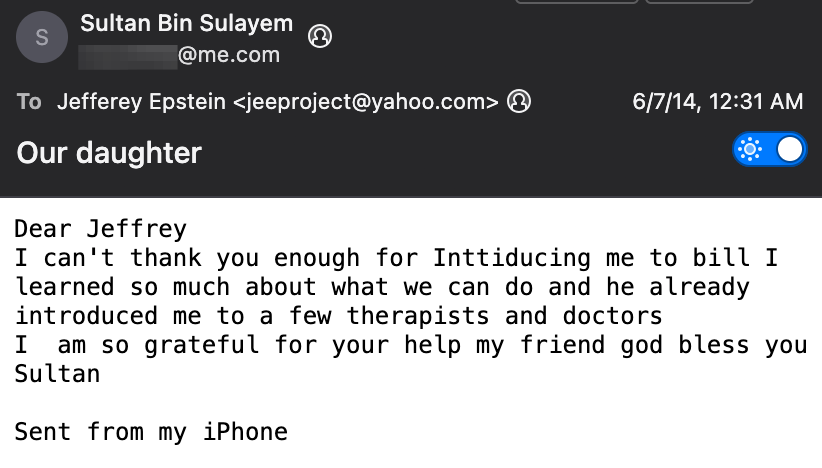
From 2014 to 2017, Epstein helped connect Sulayem with therapists and physicians, and Sulayem inquired about seeking treatment from Israeli neurologist Shai Efrati. Sulayem sent multiple emails to Epstein about Efrati, including a BBC Future article on “bringing the dead back to life,” about Efrati’s hyperbaric oxygen therapy, and a link to Efrati’s TEDx talk titled “Reverse Aging.” Sulayem asked, “Do you have contacts for these people and can you check if this help my daughter.”
Emails released by the House Oversight Committee show that access to elite medical services was one of the perks of being friends with Epstein, and he made similar medical arrangements for Steve Bannon in the same time period. “If you take a trip to palm beach. All [blood tests] etc. can be done [by] head of Mayo clinic a good friend,” Epstein wrote to Bannon in August 2018, adding a word of advice: “reminder money medicine law. JEWS only.”
Epstein’s efforts to connect Sulayem to top-flight Israeli medical care appeared to pay off in June 2018, when Sulayem sent a confirmation-of-treatment document listing his wife and children at Assaf Harofeh Medical Center (now Shamir Medical Center), where Efrati’s Sagol Center for Hyperbaric Medicine is based. Weeks later, Sulayem sent Epstein details of a children’s cancer fundraising campaign at an Israeli charity, which he planned to support.
The emails illustrate the extraordinary level of personal trust between the two men that existed through Epstein’s last years. In early 2017, after receiving an invitation from then-campaign advisor to Donald Trump and current U.S. ambassador to Turkey, Tom Barrack, to attend Trump’s first presidential inauguration, Sulayem promptly reached out to Epstein for guidance on how to navigate the offer. “Do you think it will be possible to shake hand (sic) with trump,” Sulayem wrote. Epstein replied, “very many people going. it will be very crowded . but if you can meet some before or after in either wash or ny , it might be worth it . but unlikely.”
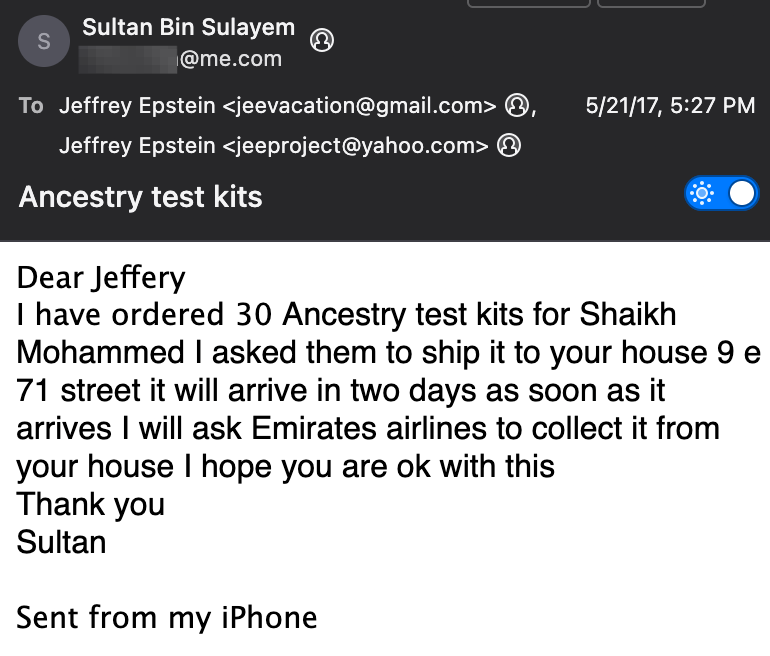
In May of the same year, Sulayem ordered 30 Ancestry DNA test kits for Sheikh Mohammed bin Rashid Al Maktoum, the ruler of Dubai, to be delivered to Epstein’s mansion and collected later by officials of Emirates Airlines.
The correspondence and friendship between Epstein and Sulayem continued right until Epstein’s second arrest on sex trafficking charges in July 2019, and his death in jail one month later. The relationship between the UAE and Israel, meanwhile, continued to develop rapidly, leading to the signing of the Abraham Accords agreement in September 2020, as well as high-profile business proposals with Sulayem at the forefront.
Two months after the Abraham Accords signing, Sulayem signed a memorandum of understanding for DP World to “assess the prospects of developing Israeli ports and free zones and establishing a maritime service between Eilat in Israel and Jebel Ali in Dubai.” His son Ahmed lauded the move as a productive step toward boosting economic and trade relations between the two countries.
In a November 2022 interview about the Abraham Accords, Epstein’s close friend Ehud Barak told journalist Afshin Rattansi, “I’m glad that the Emirates and Bahrain went ‘out of the closet’ and are ready to formalize relationships with us, and I hope that others will follow. It’s a positive development — of course, it’s not a real peace, it’s not a major breakthrough. We know these people for 25 years, and we have a very intensive relationship with them in many arenas.” (Barak walked out of the interview after Rattansi insinuated Israel’s involvement in covert support for Islamist militant groups.)
The relationship between Israel and the UAE has only deepened in the years since, even as the Israeli genocide in Gaza has provoked global outrage. In December 2025, the UAE signed a $2.3 billion defense deal with Elbit Systems, one of the largest arms sales in Israeli history.
Although Epstein did not live to see these agreements come to fruition, the private channels he helped cultivate between Emirati and Israeli elites helped make them possible. Today, those same networks are converging around support for Somaliland—with Epstein’s old friend Sultan Sulayem as one its most vocal Emirati supporters.
One doesn't have to like it, to get an idea of just how 'helpful' having Jeffrey Epstein as a friend could be, in an incredibly wide area of possibilities. Thanks for this enlightening article.
Dilated , trump some friends Epstein had